The Quick Answer: How Do I Know If My Teenager Lacks Confidence?
There is no single behaviour that proves a teenager lacks confidence.
Instead, look for patterns such as:
- avoiding new experiences;
- putting themselves down;
- constantly comparing themselves with others;
- needing frequent reassurance;
- being extremely afraid of mistakes;
- giving up quickly;
- struggling to speak up;
- avoiding social situations they actually want to join;
- letting other people make decisions for them;
- assuming failure before they begin.
One difficult week or one nervous situation does not necessarily mean there is a confidence problem.
The bigger question is:
Is self-doubt repeatedly stopping my teenager doing things they want, need or are capable of doing?
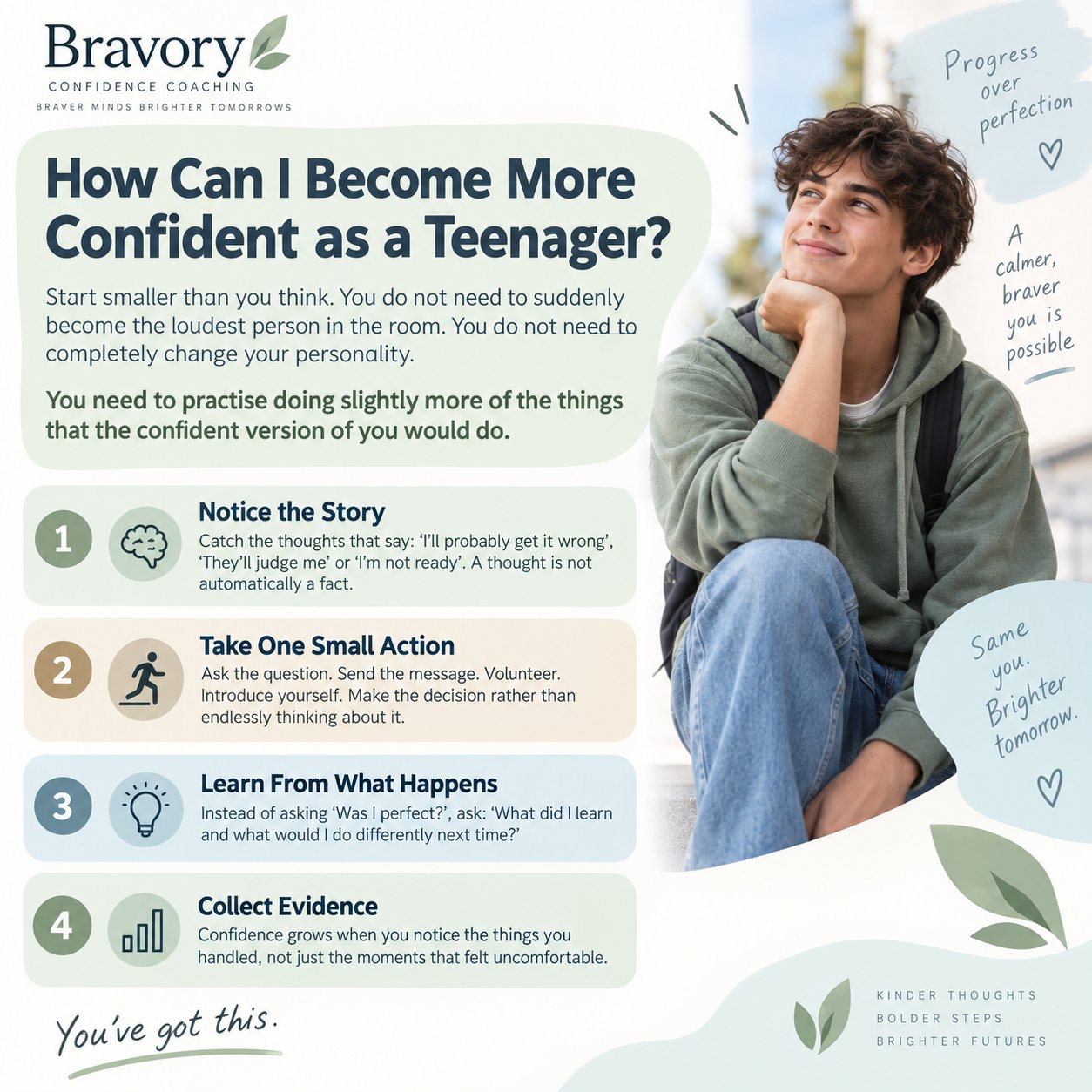
15 Signs Your Teenager May Lack Confidence
1. They Put Themselves Down
Listen for repeated phrases such as:
- “I'm useless.”
- “I'm stupid.”
- “Nobody likes me.”
- “I'm terrible at everything.”
- “There's no point.”
Everyone says negative things about themselves occasionally.
The concern is when negative self-talk becomes their normal way of describing who they are.
2. They Avoid Trying New Things
Your teenager may turn down opportunities before exploring them.
They may say:
“I don't want to.”
But underneath may be:
“What if I'm bad at it?”
Avoidance can protect them from finding out whether they might fail.
3. They Give Up Very Quickly
The first difficulty can become:
“See? I knew I couldn't do it.”
Low confidence can make ordinary learning frustration feel like proof that they are incapable.
4. They Need Constant Reassurance
They may repeatedly ask:
- “Is this right?”
- “Do you think I should do it?”
- “Do I look OK?”
- “What would you do?”
- “Are you sure?”
Reassurance can help temporarily.
But constant reassurance-seeking may suggest they do not trust their own judgement.
5. They Are Very Afraid of Making Mistakes
Some teenagers believe mistakes say something about their worth.
Instead of:
“I got this wrong.”
they think:
“I'm not good enough.”
That can lead to perfectionism, procrastination or avoidance.
6. They Constantly Compare Themselves With Others
They may compare:
- appearance;
- grades;
- friendships;
- sport;
- social media;
- popularity;
- future plans.
The danger is when someone else's success automatically becomes evidence of their own failure.
7. They Struggle to Speak Up
They may have an opinion but avoid expressing it.
They might:
- stay quiet in class;
- let friends decide;
- avoid asking questions;
- struggle to say no;
- let other people speak for them.
This can be particularly noticeable when they know what they want to say but seem unable to say it.
8. They Worry Excessively About What Other People Think
Before making a decision, they may ask:
“What will everyone think?”
Their clothes, opinions, interests, friendships and choices may become heavily influenced by avoiding judgement.
9. They Avoid Social Situations They Actually Want to Join
There is a difference between:
“I genuinely don't want to go.”
and:
“I want to go, but I'm too worried about what might happen.”
Low social confidence can lead teenagers to miss experiences they would actually enjoy.
10. They Say “I Don't Care” a Lot
Sometimes they genuinely do not care.
But sometimes:
“I don't care.”
protects them from admitting:
“I care a lot and I'm frightened I won't succeed.”
Look at behaviour as well as words.
11. They Avoid Decisions
They may constantly ask parents or friends what they should do.
Even small decisions can become difficult because they fear making the wrong choice.
Decision-making confidence is an important part of independence.
12. They Struggle With Feedback
A suggestion for improvement may feel like:
“You're saying I'm rubbish.”
rather than:
“There is something here I can improve.”
Low confidence can make feedback feel much more personal.
13. They Downplay Success
When something goes well, they may say:
- “I got lucky.”
- “It was easy.”
- “Anyone could have done it.”
- “It doesn't really count.”
They may struggle to accept evidence of their own capability.
14. They Let Other People Decide Who They Should Be
They may change:
- their opinions;
- their interests;
- how they dress;
- how they behave;
depending on who they are with.
Some adaptation is normal.
But constantly abandoning their own preferences to gain approval can signal low self-belief.
15. They Avoid Independence
Older teenagers with low confidence may continue relying heavily on parents for:
- phone calls;
- appointments;
- decisions;
- travel;
- problem-solving;
- communication with adults.
Sometimes the issue is not capability.
It is lack of confidence that they can manage alone.

Low Confidence Does Not Always Look Quiet
This is important.
Some teenagers with low confidence are quiet.
Others may become:
- loud;
- sarcastic;
- dismissive;
- defensive;
- overly competitive;
- determined to look as though nothing bothers them.
Confidence is not simply about volume.
Sometimes a very loud exterior is protecting a very uncertain interior.
Low Confidence or Just a Quiet Personality?
A quiet teenager does not automatically lack confidence.
Introversion is not a problem to fix.
Ask:
Are they choosing quietness because that suits them?
Or:
Are they staying quiet because fear is stopping them doing something they actually want to do?
That distinction matters.
A teenager can be quiet, reflective and highly confident.
Low Confidence or a Bad Week?
Teenagers have difficult days.
Friendships change.
Exams happen.
Relationships end.
They may temporarily withdraw or doubt themselves.
Rather than reacting to one incident, look for:
- how long the behaviour has been present;
- whether it appears in several areas of life;
- whether it is getting worse;
- whether it is stopping them doing ordinary things;
- whether they seem distressed by it.
Patterns usually tell you more than isolated moments.
Is Perfectionism a Sign of Low Confidence?
It can be.
A perfectionist teenager may appear highly capable.
They may achieve excellent results.
But underneath may be:
“If I don't do this perfectly, people will realise I'm not good enough.”
Look for:
- extreme distress over small mistakes;
- procrastination because work cannot feel perfect;
- avoiding subjects or activities they may not excel at;
- difficulty accepting praise;
- unrealistically high standards.
Healthy ambition and perfectionism are not the same thing.
Can Procrastination Be a Confidence Problem?
Sometimes.
A teenager may delay starting because starting creates the possibility of failing.
Then if the result is poor, they can tell themselves:
“I only did badly because I left it late.”
That can feel safer than:
“I tried my hardest and it still wasn't perfect.”
So when procrastination appears repeatedly, consider whether fear of failure may be underneath it.
What Is Hiding Underneath “I Can't Be Bothered”?
Sometimes it really does mean:
“I can't be bothered.”
Teenagers are teenagers.
But sometimes it means:
- “I'm scared I'll fail.”
- “I don't think I'm good enough.”
- “I don't want everyone to see me struggle.”
- “I don't know where to start.”
- “I'm worried I'll embarrass myself.”
Try becoming curious before immediately labelling the behaviour as laziness.
Instead of:
“Why can't you be bothered?”
try:
“What is making this difficult to start?”
Five Areas of Teen Confidence to Look At
Rather than asking only:
“Is my teenager confident?”
break confidence into different areas.
Self-Belief
Do they generally believe they are capable and worthwhile?
Communication
Can they ask questions, express views and speak up?
Resilience
Can they recover when something goes wrong?
Social Confidence
Can they meet people, join in and handle ordinary social uncertainty?
Independence
Are they gradually becoming able to decide, organise and handle more for themselves?
A teenager may be confident in one area and struggle greatly in another.
That is why a single label such as “confident” or “not confident” is often too simplistic.
The Bravory Confidence Pattern Check
Think about the last month rather than one difficult day.
Ask yourself:
Does my teenager regularly avoid things because they think they cannot do them?
Do they need reassurance before ordinary decisions?
Do they speak negatively about themselves?
Do they worry excessively about other people's opinions?
Do mistakes affect them disproportionately?
Do they give up quickly when something feels difficult?
Are they relying on me for things they could probably begin doing themselves?
Is their lack of confidence narrowing their world?
You are not trying to diagnose them.
You are looking for patterns that suggest confidence may need support.
What Should I Do If I Think My Teenager Lacks Confidence?
Avoid starting with:
“You have no confidence.”
That can become another label.
Instead, talk about something specific you have noticed.
For example:
“I've noticed you've been turning down quite a few things recently, even things you used to enjoy. How are you feeling about them?”
Or:
“You seem to be really hard on yourself when something goes wrong. What's going through your head?”
Specific observations create better conversations than labels.
Ask Before You Advise
When your teenager opens up, your first instinct may be to reassure:
“You're brilliant. Don't worry.”
But try curiosity first.
Ask:
- “What part feels hardest?”
- “What are you worried might happen?”
- “What do you think?”
- “What would help?”
- “What would be one small step?”
This helps you understand the actual confidence problem rather than guessing.
Do Not Try to Fix Every Sign at Once
If you recognise eight of the signs above, do not create an eight-point improvement plan tonight.
Start with the area causing the biggest limitation.
Maybe that is:
- social confidence;
- fear of mistakes;
- speaking up;
- decision-making;
- independence;
- overthinking.
Confidence develops more effectively through manageable changes than through feeling like another problem that needs fixing.
What Not to Say to a Teenager Who Lacks Confidence
“Just Be Confident.”
They probably would if they knew how.
“Stop Worrying.”
This gives them no useful next step.
“Your Friend Can Do It.”
Comparison can create more self-doubt.
“There's Nothing to Be Nervous About.”
It may feel very real to them.
“I'll Do It for You.”
Sometimes necessary, but doing everything removes opportunities to build capability.
“You're Too Sensitive.”
This can close the conversation rather than help them understand what is happening.
What Can Parents Do Instead?
Focus on experiences that create evidence.
Encourage your teenager to:
- make one decision;
- ask one question;
- try one new thing;
- make one phone call;
- handle one minor problem;
- recover from one setback;
- speak for themselves in one situation.
Then notice it.
Say:
“You handled that yourself.”
That is more useful than simply repeating:
“You should be more confident.”
Which Bravory Guide Should I Read Next?
Different signs point towards different next steps.
They Rely on You for Decisions
Explore decision-making and growing independence.
Decision-Making SkillsTake the Bravory Teen Confidence Scorecard
If you are still asking:
“Does my teenager actually lack confidence, and where?”
the Bravory Teen Confidence Scorecard gives you a useful next step.
It explores:
- self-belief and inner confidence;
- communication and speaking up;
- resilience after setbacks;
- friendships and social courage;
- readiness for independence.
It is a reflection tool, not a diagnosis.
Take the Teen Confidence ScorecardUse Better Questions to Understand What Is Going On
Sometimes the hardest part is getting your teenager to talk.
Rather than:
“What's wrong with you?”
try:
- “What has been hardest recently?”
- “Is there something you're worrying about?”
- “When do you feel least confident?”
- “What do you wish felt easier?”
- “Do you want me to listen or help you think it through?”
The Bravory Parent Conversation Kit contains 25 questions designed to help parents talk with teenagers about confidence, pressure, friendships, motivation and their future.
Explore the Parent Conversation KitThe BRAVE Method and Low Confidence
Bravory uses the BRAVE Method to turn confidence into practical behaviours.
B — Belief
Does your teenager believe they have ability and value?
R — Resilience
Can they recover when things go wrong?
A — Action
Can they act despite some nerves or uncertainty?
V — Voice
Can they ask, speak, disagree and explain what they need?
E — Evidence
Do they notice what they successfully handle, or only what goes wrong?
When Low Confidence May Need More Than Confidence Support
Bravory focuses on confidence, communication, resilience, independence and personal development.
It is not therapy, counselling or mental-health treatment.
Some behaviours that look like low confidence may sit alongside a more significant difficulty.
Seek appropriate professional support if your teenager is experiencing severe or persistent:
- anxiety or panic;
- depression;
- school refusal;
- significant withdrawal;
- self-harm or suicidal thoughts;
- eating difficulties;
- trauma;
- bullying or abuse;
- major changes in behaviour;
- or another safeguarding concern.
Depending on the situation, speak with a GP, school pastoral or safeguarding team, counsellor, qualified mental-health professional or emergency service where urgent help is required.
How the Bravory 6-Week Confidence Programme Can Help
Recognising the signs is only the starting point.
Confidence changes through practice.
The Bravory 6-Week Teen Confidence Mastery Programme helps teenagers and young adults develop:
- self-belief;
- awareness of negative self-talk;
- communication;
- resilience;
- decision-making;
- social confidence;
- greater independence;
- confidence taking action.
The programme focuses on practical action and encourages young people to collect evidence of what they can handle rather than simply being told to feel more confident.
Explore the 6-Week Teen Confidence ProgrammeFrequently Asked Questions About Signs of Low Confidence in Teenagers
How do I know if my teenager lacks confidence?
Look for repeated patterns such as avoiding unfamiliar situations, negative self-talk, constant reassurance-seeking, fear of mistakes, giving up quickly, struggling to speak up, negative comparison with others and relying heavily on other people to make decisions.
What are the most common signs of low confidence in teenagers?
Common signs can include avoidance, perfectionism, procrastination, fear of judgement, difficulty accepting feedback, negative self-talk, social withdrawal, reassurance-seeking and reluctance to try new things.
Can a confident-looking teenager actually have low confidence?
Yes. Some teenagers hide self-doubt behind humour, loud behaviour, apparent indifference, defensiveness or high achievement. Confidence cannot be judged purely by how outgoing someone appears.
Is shyness the same as low confidence?
No. A quiet or introverted teenager may be perfectly confident. The important question is whether fear or self-doubt is stopping them doing things they genuinely want or need to do.
Can perfectionism be a sign of low confidence?
It can be. Some teenagers feel they must perform perfectly because mistakes feel like evidence that they are not good enough. Healthy high standards and fear-based perfectionism are different.
Why does my teenager always need reassurance?
Frequent reassurance may indicate that they do not yet trust their own judgement. Instead of immediately giving the answer, ask what they think first and help them work through the decision.
What should I do if I think my teenager has low confidence?
Start with a calm conversation about specific behaviours you have noticed. Listen before giving advice, identify where confidence seems weakest and encourage manageable opportunities to make decisions, communicate, try things and recover from setbacks.
Can Bravory help a teenager with low confidence?
Bravory provides practical confidence-building support for teenagers and young adults through confidence assessments, parent resources and the 6-Week Teen Confidence Mastery Programme, focusing on self-belief, resilience, action, communication and evidence.
Look for the Gap Between Ability and Action
A useful way to think about teenage confidence is to look at the gap between:
what your teenager is capable of
and:
what they actually allow themselves to do.
Do they know the answer but never speak?
Want friends but avoid meeting people?
Have ability but refuse opportunities?
Want independence but constantly hand decisions back to you?
That gap can tell you far more than simply asking:
“Are you confident?”
Low confidence often shows itself not in what a teenager cannot do, but in what they believe they cannot do.
Not Sure Where Your Teenager's Confidence Is Getting Stuck?
Do not start by trying to fix everything.
Start by understanding the pattern.
Is it:
self-belief?
communication?
resilience?
social confidence?
independence?
Once you know the area, the next step becomes much clearer.
Take the Teen Confidence Scorecard Explore the 6-Week Confidence Programme