The Biggest Problem With Fear of Failure Isn't Failure
It's what fear makes you avoid.
If you're afraid of getting things wrong, you may start protecting yourself.
You don't volunteer.
You don't apply.
You don't answer the question.
You don't join.
You don't try something until you're sure you'll be good at it.
And on the surface that can feel safe.
But there is a hidden cost.
You also lose the chance to discover what you might have been capable of.
Sometimes fear of failure doesn't make you fail. It makes you avoid the opportunity to succeed.
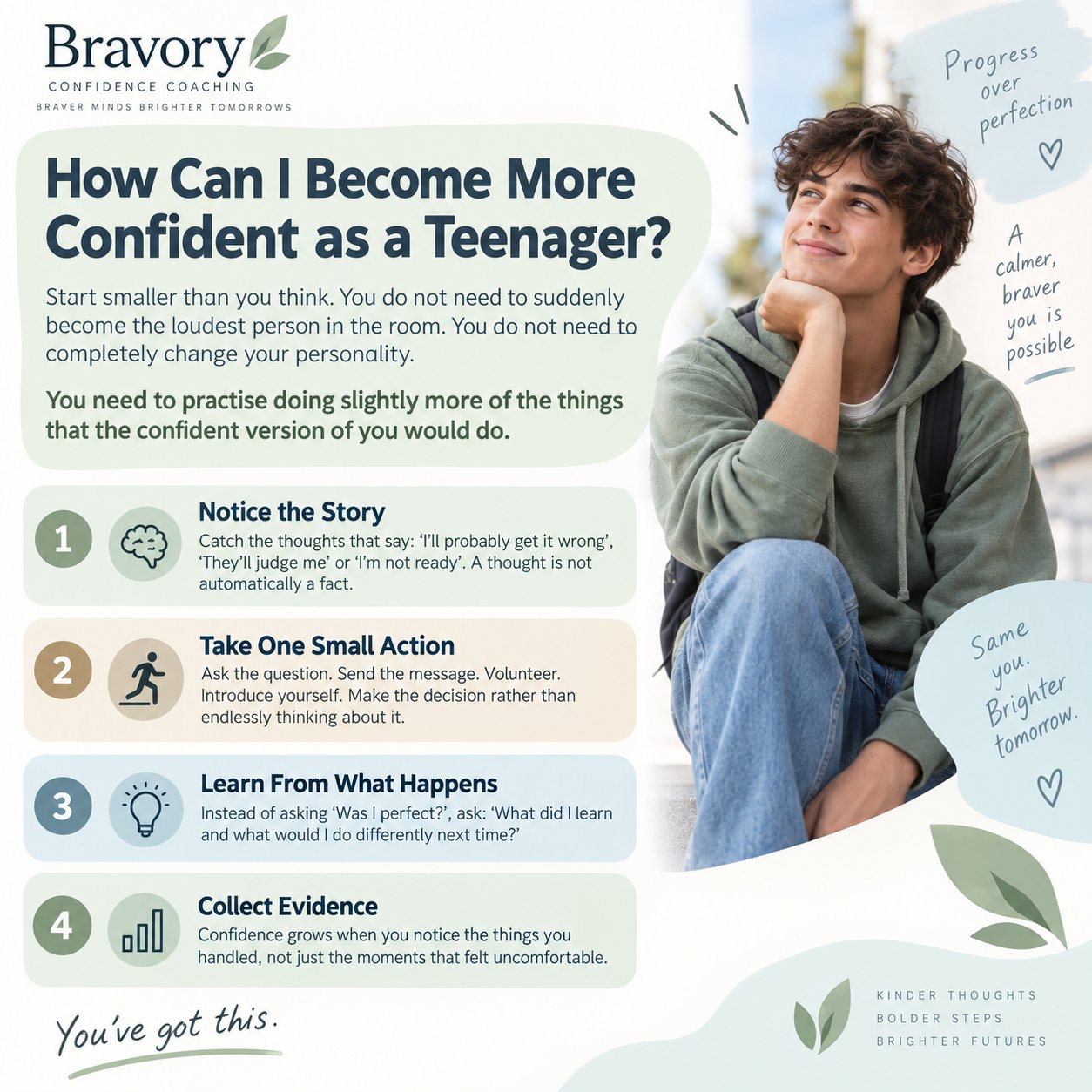
What Does Fear of Failure Look Like in Teenagers?
Fear of failure does not always look like fear.
Sometimes it can look like:
Procrastination
You keep putting something off because starting means discovering whether you can actually do it.
Perfectionism
If something cannot be done perfectly, you would rather not do it at all.
Giving Up Quickly
The first difficulty becomes evidence that you should stop.
Avoiding Challenges
You stay with things you already know you can do rather than risk being a beginner.
Making Excuses
“I wasn't bothered anyway” can sometimes protect you from admitting that you really wanted something.
Overthinking
You analyse every possible outcome until doing nothing feels safer than choosing.
Needing Reassurance
You repeatedly ask whether you are doing something correctly because getting it wrong feels threatening.
Comparing Yourself
You look at people who are already good at something and forget they were once beginners too.
“What If I Get It Wrong?”
This question can quietly control a lot of teenage decisions.
What if I get the answer wrong?
What if I fail the exam?
What if I don't make the team?
What if I don't get the job?
What if I say the wrong thing?
What if I look stupid?
What if I disappoint people?
What if everyone else is better than me?
There is one problem with trying to remove all possibility of failure:
You would have to stop doing almost anything that matters.
Anything worthwhile usually contains some uncertainty.
Why Are Some Teenagers So Afraid of Making Mistakes?
There isn't usually one simple cause.
Fear of failure can grow from several different experiences and beliefs.
- Putting very high expectations on yourself.
- Feeling that people expect you to achieve.
- Comparing yourself with high-achieving friends or siblings.
- Believing mistakes make you look stupid.
- Being praised mainly for results rather than effort and learning.
- Having experienced criticism or embarrassment after getting something wrong.
- Wanting to make parents, teachers or coaches proud.
- Social media making everybody else's success look effortless.
- Believing capable people should get things right first time.
- Low self-belief underneath high expectations.
Sometimes teenagers who appear highly motivated are actually carrying enormous fear underneath.
Their thinking becomes:
“I have to succeed.”
rather than:
“I want to do my best and see what I can learn.”
Fear of Failure and Perfectionism in Teenagers
Perfectionism can look impressive from the outside.
High standards.
Careful work.
Strong results.
But there is a difference between wanting to do something well and believing it must be perfect.
Healthy High Standards
“I want to do my best.”
Perfectionism
“If this isn't excellent, I've failed.”
Healthy Learning
“Mistakes show me what to work on.”
Fear-Based Thinking
“Mistakes prove I'm not good enough.”
Perfectionism can become a trap because the standard for feeling successful keeps moving.
Fear of Failure Can Look Like Laziness
This is particularly important for parents.
A teenager who refuses to revise, will not apply for something or gives up quickly can look unmotivated.
Sometimes they are.
But sometimes another thought is sitting underneath:
“If I genuinely try and still fail, what does that say about me?”
Not trying creates an escape route.
They can tell themselves:
“I would have done better if I'd actually tried.”
That can feel psychologically safer than putting everything in and discovering the result is still imperfect.
Before assuming:
“Why can't you be bothered?”
consider asking:
“What are you worried might happen if you really try?”

How to Overcome Fear of Failure as a Teenager
The goal is not to learn how to guarantee success.
The goal is to become less frightened of what happens when success is not guaranteed.
1. Change the Question
Instead of asking:
“What if I fail?”
ask:
“What could I learn if I try?”
That changes the purpose from proving yourself to developing yourself.
2. Separate Mistakes From Identity
There is a huge difference between:
“I got that wrong.”
and:
“I'm useless.”
One describes an event.
The other attacks the person.
Practise keeping the two separate.
3. Make Some Mistakes on Purpose
Not dangerous ones.
Small, safe imperfections.
Try:
- answering before you are completely certain;
- trying a hobby you know you will initially be bad at;
- sharing an idea that is not fully polished;
- attempting something without researching it for hours first;
- allowing something unimportant to be “good enough”.
Your brain starts learning:
“Getting something wrong is uncomfortable — but manageable.”
4. Make the Goal Smaller
If the goal is:
“Be brilliant at public speaking,”
failure feels enormous.
Try:
“Say one thing in the discussion.”
If the goal is:
“Get the perfect job,”
try:
“Submit one application.”
Small actions create experience.
5. Decide What Success Means Before You Start
Success does not always have to mean winning.
Success might mean:
- I tried.
- I showed up.
- I finished.
- I asked.
- I learned something.
- I handled the disappointment.
- I tried again.
That gives you more than one way to make progress.
6. Stop Predicting Everyone's Reaction
Fear of failure often contains another fear:
“What will everyone think?”
Ask yourself:
- Who exactly am I worried about?
- What do I think they will say?
- Do I actually know that?
- Whose opinion genuinely matters?
Your imaginary audience should not make every real-world decision.
7. Review Instead of Judge
After something goes wrong, do not immediately ask:
“Was I good enough?”
Ask:
- What worked?
- What didn't?
- What did I learn?
- What would I change?
- What is my next attempt?
That turns mistakes into information.
8. Try Again Before the Fear Gets Bigger
One bad experience can become enormous if you never return to it.
If appropriate, make another attempt.
Not because you have to prove anything.
Because your brain needs the chance to discover that the first outcome was not the end of the story.
The Difference Between Failure and Feedback
Imagine you apply for a Saturday job and don't get it.
Failure thinking says:
“I'm obviously terrible at interviews.”
Feedback thinking asks:
- Was my application strong?
- Did I prepare enough?
- How did I answer the questions?
- Could I ask for feedback?
- What would I change next time?
- Where else can I apply?
One response closes the door.
The other gives you somewhere to go next.
A mistake becomes much more useful when you stop using it as evidence against yourself.
The Bravory “What If I Fail?” Challenge
Think of something you are currently avoiding because you're worried about getting it wrong.
1. What exactly am I afraid might happen?
2. How likely is that outcome really?
3. If it did happen, what could I do?
4. What might I gain by trying?
5. What might I lose by never trying?
6. What is the smallest brave action I can take?
That fifth question is important.
We often think about the risk of failure.
We think far less about the risk of avoiding.
What If I Fail in Front of Other People?
Sometimes failure itself is not the biggest fear.
Being seen failing is.
You might be less worried about getting an answer wrong than about everybody hearing you get it wrong.
Less worried about not making the team than having to tell your friends.
Less worried about an unsuccessful interview than telling your parents.
This is where fear of failure and fear of judgement meet.
Ask:
“If somebody sees me try and fail, what does that actually say about me?”
One possible answer is:
“I was willing to try something where success wasn't guaranteed.”
That sounds rather different.
Fear of Failure at School and College
Academic pressure can make mistakes feel much bigger than they are.
Teenagers may worry about:
- exam results;
- coursework;
- answering questions incorrectly;
- being moved sets;
- not meeting predicted grades;
- disappointing parents or teachers;
- getting into university;
- being compared with classmates.
Results matter.
But one mark should not become a judgement of a young person's entire ability.
After a disappointing result, ask:
What does this result tell us?
What needs more work?
What support might help?
What happens next?
Fear of Failure in Sport
Sport can be brilliant for confidence.
It can also expose young people to selection, comparison, winning, losing and visible mistakes.
A missed penalty, dropped catch, bad race or unsuccessful trial can feel very public.
Help the young person separate:
performance
from:
identity.
You can perform badly on a day without becoming a bad athlete.
Then ask:
“What would you work on before the next attempt?”
Fear of Failure When Applying for Jobs
Young people entering work can easily think:
“What if they reject me?”
They probably will eventually.
Almost everybody experiences rejection.
A more useful objective is:
become better at applying.
Each application can help you practise:
- writing;
- interviews;
- talking about your strengths;
- handling nerves;
- asking for feedback;
- recovering from disappointment.
The successful application may come after several unsuccessful ones.
Fear of Failure and Trying Something New
The first stage of learning can be uncomfortable because you are visibly a beginner.
You may not know what you're doing.
Good.
That's why you're learning.
Try replacing:
“Am I good at this?”
with:
“Am I getting better?”
Those questions create completely different experiences.
How Parents Can Help a Teenager Who Is Afraid of Failure
Fear of failure can be difficult to watch because parents can often see how capable their teenager is.
You want to tell them:
“You'll be fine.”
But sometimes they do not need a guarantee.
They need confidence that they can cope even if the outcome is disappointing.
Try asking:
- “What are you most worried might happen?”
- “If it didn't work, what could you do next?”
- “What would you learn by trying?”
- “What does success look like besides winning?”
- “What's the smallest step you could take?”
- “What would you tell a friend in the same situation?”
These questions move the conversation away from guaranteeing the outcome and towards building confidence in their ability to handle it.
Praise the Things That Come Before Success
If young people only hear praise when the outcome is excellent, they can begin connecting approval with achievement.
Notice:
- effort;
- preparation;
- courage;
- asking for feedback;
- trying again;
- changing approach;
- honesty about mistakes;
- recovery after disappointment.
Try saying:
“I know you were nervous about that, and you still gave it a go.”
That reinforces courage, not just results.
Be Careful With “You're So Clever”
Positive encouragement matters.
But if a young person becomes very attached to an identity such as:
“I'm the clever one”
or:
“I'm the sporty one,”
failure can feel like a threat to who they are.
Balance praise for ability with recognition of:
- effort;
- curiosity;
- learning;
- practice;
- adaptability;
- resilience.
That leaves more room for mistakes.
Don't Remove Every Chance to Fail
Parents naturally want to protect their children.
But confidence needs evidence.
And resilience needs some experience of things not going perfectly.
Where it is safe and age-appropriate, allow teenagers to:
- make decisions;
- get some things wrong;
- experience manageable consequences;
- have difficult conversations;
- solve everyday problems;
- try again.
Then help them reflect rather than immediately rescue.
The BRAVE Method and Fear of Failure
Fear of failure connects directly with the Bravory BRAVE Method.
B — Belief
Learn that mistakes do not determine your worth or potential.
R — Resilience
Discover that disappointment, rejection and failure can be handled.
A — Action
Take useful action even when success is not guaranteed.
V — Voice
Ask for help, admit when you are unsure and talk openly about mistakes.
E — Evidence
Collect examples of things you tried, learned from and recovered from.
Try the Bravory “Mistake of the Week” Exercise
This might sound strange.
But try asking:
What mistake did I make this week?
What happened?
What did I learn?
What will I do differently?
What does this prove I survived?
The aim is not to celebrate careless mistakes.
It is to remove the idea that every mistake must be hidden or feared.
Fear of Failure and Overthinking
Fear of failure often creates overthinking because your mind is trying to find a way to guarantee the future.
Should I do it?
What if this happens?
What if that happens?
What if I regret it?
Eventually there is so much analysis that nothing happens.
If this sounds familiar, explore the Bravory overthinking guide too.
Explore Teen Overthinking HelpFear of Failure and Resilience
Resilience is not avoiding failure.
It is knowing what to do afterwards.
That means these two Bravory topics work closely together.
If your teenager finds setbacks particularly hard, the dedicated resilience guide explores how to recover, reflect and try again.
Explore Teen ResilienceTake the Bravory Teen Confidence Scorecard
Fear of failure rarely exists completely on its own.
It may connect with:
- self-belief;
- resilience;
- communication;
- fear of judgement;
- overthinking;
- social confidence;
- independence.
The Bravory Teen Confidence Scorecard explores self-belief, communication, resilience after setbacks, friendships and social courage, and readiness for independence. :contentReference[oaicite:1]{index=1}
Take the Teen Confidence ScorecardMove From Fear to Action With the 6-Week Bravory Programme
Understanding fear of failure is useful.
But confidence grows when the young person starts doing things differently.
The Bravory 6-Week Teen Confidence Mastery Programme helps teenagers and young adults work on:
- their inner critic;
- self-belief;
- fear of getting things wrong;
- overthinking;
- communication;
- decision-making;
- resilience;
- social confidence;
- taking action before everything feels perfect.
The Bravory programme is designed around short learning, reflection and real-world confidence actions, including a 30-day Confidence Building Challenge. :contentReference[oaicite:2]{index=2}
Explore the 6-Week Teen Confidence ProgrammeExplore More Bravory Support
Teen Confidence Scorecard
Explore self-belief, resilience, communication, social courage and independence.
Take the ScorecardTeen Resilience
Learn how to bounce back after disappointment, mistakes and setbacks.
Explore ResilienceTeen Overthinking Help
Learn how to stop repeatedly analysing everything and begin taking useful action.
Explore Overthinking HelpFear of Judgement
Explore what happens when worrying about other people's opinions makes failure feel even more frightening.
Read the GuideCommunication Skills
Develop the confidence to ask questions, admit mistakes and speak up.
Explore Communication Skills6-Week Confidence Programme
Turn self-belief and courage into practical everyday action.
Explore the ProgrammeWhen Fear of Failure May Need Additional Support
Most people dislike failing.
Bravory focuses on confidence, resilience, communication and personal development.
It is not therapy, counselling or mental-health treatment.
If fear of failure is causing severe or persistent distress, panic, significant anxiety, school refusal, extreme perfectionism, depression, self-harm, an eating disorder or a major impact on everyday life, appropriate professional support may be needed.
Consider speaking with a GP, school pastoral or safeguarding team, counsellor or appropriately qualified mental-health professional where necessary.
Frequently Asked Questions About Fear of Failure in Teenagers
Why is my teenager so afraid of making mistakes?
A teenager may fear mistakes because they connect getting something wrong with embarrassment, disappointment, criticism or not being good enough. High expectations, perfectionism, social comparison and fear of judgement can all contribute.
How can I help a teenager who is afraid of failure?
Help them separate mistakes from identity, focus on learning rather than perfect outcomes, break challenges into smaller steps, praise courage and recovery, and give them manageable opportunities to try things where success is not guaranteed.
Why does my teenager give up before trying?
Sometimes avoiding the attempt feels safer than trying hard and risking disappointment. Ask what they fear might happen if they genuinely try rather than assuming the problem is simply laziness or lack of motivation.
What is perfectionism in teenagers?
Perfectionism can involve believing that mistakes are unacceptable, setting excessively high standards or feeling that anything less than an excellent result represents failure.
How can teenagers stop being scared of failure?
Start with manageable challenges, redefine success to include effort and learning, practise tolerating small mistakes, review outcomes rather than judging yourself and take another step after setbacks.
Can fear of failure cause procrastination?
Fear of getting something wrong can sometimes lead people to delay starting because avoiding the task temporarily removes the possibility of failing at it.
Can confidence help with fear of failure?
Yes. Confidence can help young people trust that even if something does not work, they can learn, recover and decide what to do next. Confidence is not believing that you will always succeed.
Does Bravory help teenagers who fear failure?
Bravory helps teenagers and young adults build self-belief, resilience, communication and courage through practical action. Its confidence programme includes managing the inner critic, decision-making, reducing overthinking and taking action without waiting for everything to feel perfect.
You Don't Need to Stop Caring About the Result
Wanting to succeed is not the problem.
Working hard is not the problem.
Having ambition is not the problem.
The problem comes when the fear of not succeeding becomes so powerful that you stop taking chances.
There will be things you try and don't get.
There will be answers you get wrong.
There will be interviews that don't lead to jobs.
There will be ideas that don't work.
There will be moments you wish you had handled differently.
That does not mean you're failing at life.
It means you're participating in it.
A confident person isn't someone who knows they won't fail. It is someone who increasingly trusts themselves to deal with what happens if they do.
What Would You Try If Failure Wasn't a Verdict?
Think about something you are currently avoiding.
Maybe it's:
an application, a conversation, a sport, a club, an interview, an audition, a question, an idea, or something completely different.
Then ask:
“What would I try if getting it wrong simply meant I learned something?”
Take one small step.
Not because success is guaranteed.
Because confidence grows when you discover that it doesn't have to be.
Explore the 6-Week Teen Confidence Programme Take the Teen Confidence Scorecard