The Biggest Communication Problem Isn't Always Knowing What to Say
A lot of teenagers know what they think.
The difficulty is saying it.
Perhaps you have experienced something like this:
- You have a question in class but don't put your hand up.
- Someone asks your opinion and you say, “I don't mind.”
- You disagree with your friends but go along with them anyway.
- You need help but feel embarrassed asking.
- You want to say no but end up saying yes.
- You rehearse a conversation repeatedly but never actually start it.
- You know something is bothering you but cannot explain it properly.
- You avoid speaking to adults because you're worried you'll sound stupid.
If that sounds familiar, the problem may not be that you are “bad at communication”.
You may simply need more practice using your voice.
Communication confidence grows when you learn that your voice does not have to be perfect to be worth hearing.
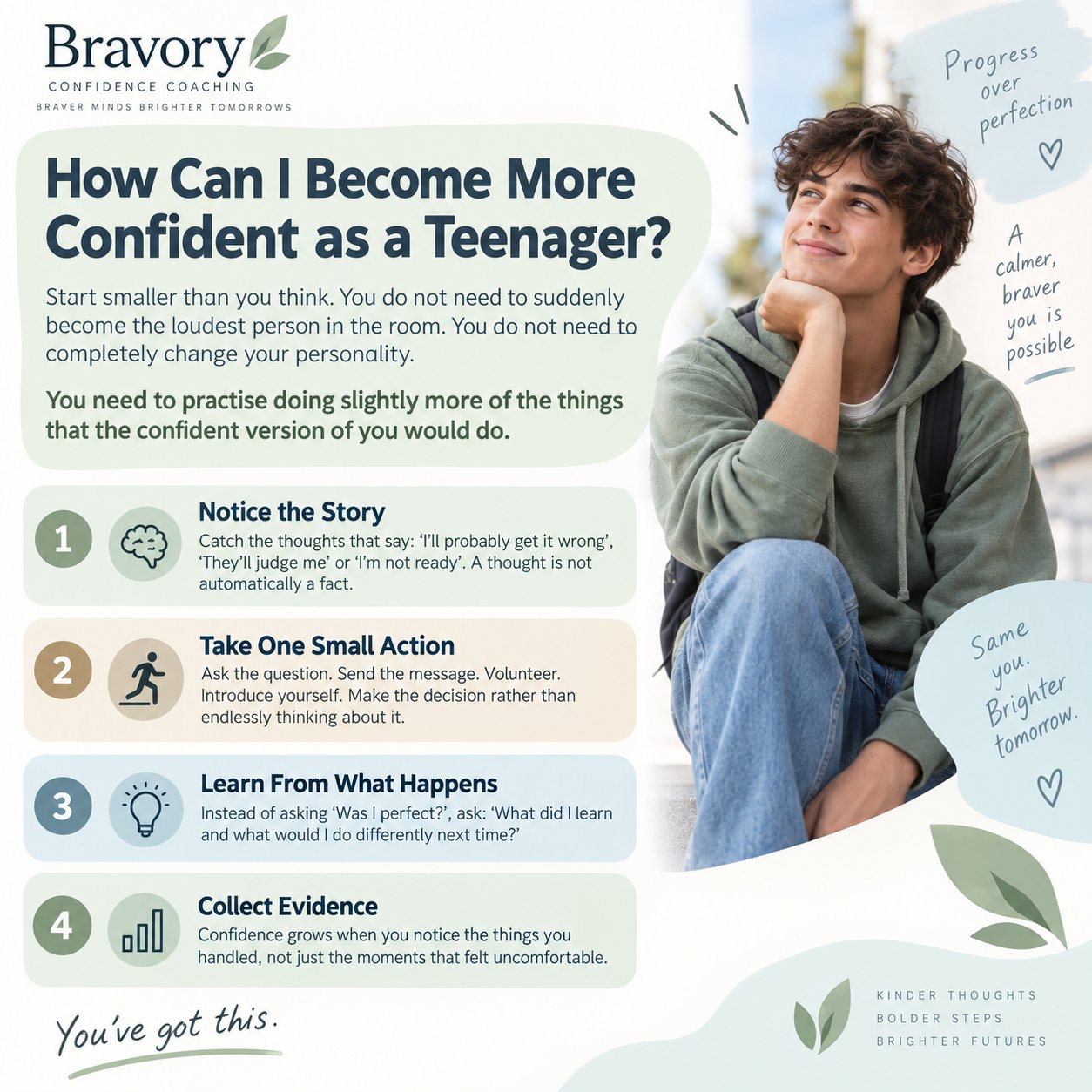
What Are Good Communication Skills for Teenagers?
Communication is much more than talking.
Good communication involves several different skills.
Speaking Clearly
Being able to explain what you mean without expecting other people to guess.
Listening Properly
Paying attention to understand rather than simply waiting for your turn to speak.
Asking Questions
Being willing to admit when you don't understand and ask for the information you need.
Expressing Opinions
Being able to say what you genuinely think respectfully, even when somebody else disagrees.
Saying No
Setting reasonable boundaries instead of agreeing to everything because you are worried about disappointing people.
Handling Disagreement
Being able to disagree without turning the conversation into an argument.
Reading the Situation
Noticing body language, tone of voice and how other people are responding.
Having Difficult Conversations
Dealing with problems rather than avoiding them until they become bigger.
Why Do Some Teenagers Struggle to Communicate Confidently?
There can be lots of reasons.
Sometimes it is shyness.
Sometimes it is fear of judgement.
Sometimes it is overthinking.
Sometimes a teenager simply hasn't had enough opportunities to practise speaking for themselves.
Thoughts might include:
- What if I say the wrong thing?
- What if they disagree?
- What if I sound stupid?
- What if I upset them?
- What if they laugh?
- What if I can't explain myself properly?
- What if an adult doesn't take me seriously?
So staying quiet feels safer.
But there is a problem.
Every time somebody else speaks for you, answers for you or makes the decision for you, you lose another opportunity to practise.
The aim isn't to remove every nervous feeling before you speak.
It is to learn that you can communicate even when you feel slightly uncomfortable.
Teen Communication Skills Matter Far Beyond School
Communication isn't just a classroom skill.
Before long, teenagers may need to:
- Attend college or university
- Go to an interview
- Start an apprenticeship
- Ask a manager a question
- Speak to customers
- Make telephone calls
- Book appointments
- Work with colleagues
- Deal with disagreements
- Explain when something is wrong
- Ask for support
- And stand up for themselves appropriately
These are not just communication skills.
They are independence skills.
How to Improve Communication Skills as a Teenager
Like most skills, communication becomes easier with practice.
You don't need to start with the conversation you find most frightening.
Start smaller.
1. Say What You Actually Think
Notice how often your answer is:
“I don't mind.”
Sometimes you genuinely don't mind.
But sometimes it really means:
“I don't want to risk choosing.”
Practise having an opinion.
Try:
- “I'd prefer...”
- “I think...”
- “I'd rather...”
- “My view is...”
- “I don't agree, because...”
Your opinion doesn't need to win.
It simply deserves to exist.
2. Ask the Question
If you don't understand something, asking is usually more useful than pretending.
Try:
- “Could you explain that again?”
- “What does that mean?”
- “Can you show me?”
- “When does that need to be done?”
- “Can I check I've understood this correctly?”
Confident communication doesn't mean knowing everything.
Sometimes confidence means being comfortable enough to say:
“I don't know.”
3. Stop Rehearsing Every Sentence
Planning an important conversation can be useful.
But there is a difference between preparing and trying to write the whole conversation in your head.
You cannot predict exactly what the other person will say.
Decide:
- What you need to communicate
- What outcome you would like
- And how you want to say it
Then have the conversation.
4. Listen to Understand
Good communicators do not just talk well.
They listen.
Try to understand the other person's point before deciding what you will say next.
Useful phrases include:
- “So what you're saying is...”
- “Have I understood you correctly?”
- “Tell me more about that.”
- “Why do you see it that way?”
Listening is not the same as agreeing.
5. Practise Speaking to Adults
Parents often speak on behalf of teenagers because it feels quicker.
But learning to communicate with adults is important.
Practise:
- Ordering your own food
- Asking for something in a shop
- Speaking to a teacher
- Making an appointment
- Asking a coach a question
- Making a telephone call
- Speaking to somebody at work
Every small interaction creates useful experience.
6. Learn to Say No Clearly
Communication confidence includes boundaries.
You do not need a ten-minute excuse every time you don't want to do something.
Depending on the situation, you might say:
- “No thanks.”
- “I don't want to do that.”
- “I can't today.”
- “I'm not comfortable with that.”
- “I'd rather not.”
Being polite does not require saying yes.
7. Make Eye Contact - Without Staring
You don't need to stare at somebody continuously.
Natural eye contact means looking at the person regularly while you speak and listen.
It helps show that you are engaged in the conversation.
8. Slow Down
Nerves can make people speak quickly.
Take a breath.
Pause between thoughts.
You do not have to answer instantly.
A short pause often makes you sound more confident, not less.

The Bravory Three-Part Communication Formula
When you are unsure what to say, try this simple structure:
Think → Say → Check
Think: What do I actually need this person to understand?
Say: Explain it clearly and simply.
Check: Ask whether they understood or invite them to respond.
For example:
Think: “I need my friend to understand that I didn't like what happened.”
Say: “I wasn't comfortable with what happened yesterday.”
Check: “Can I explain why?”
Good communication often becomes easier when you stop trying to say everything perfectly.
How to Speak Up Without Sounding Rude
Teenagers sometimes stay silent because they think the only alternatives are:
say nothing
or
start an argument.
There is another option:
assertive communication.
Passive
“Whatever you want is fine.”
Your needs disappear from the conversation.
Aggressive
“You're wrong. We're doing it my way.”
Your needs dominate everybody else's.
Assertive
“I understand what you're saying, but I'd prefer...”
Your needs and their needs are both allowed into the conversation.
Confidence isn't speaking louder. It is being clear enough that you don't need to.
Try the “I Think – I Feel – I Need” Formula
When a conversation feels difficult, this simple format can help you organise your thoughts.
I think...
I feel...
I need / would like...
For example:
“I think we're misunderstanding each other. I feel frustrated because I don't think I've explained myself properly. I'd like to start again.”
Or:
“I feel uncomfortable when everyone jokes about that. I'd like you to stop.”
You don't have to use those exact words.
The structure simply helps you communicate what is happening without immediately blaming the other person.
How to Have a Difficult Conversation as a Teenager
Avoiding difficult conversations can feel easier in the short term.
But unresolved problems often become harder.
Before the conversation, ask yourself:
- What actually happened?
- What do I need them to understand?
- What outcome would be useful?
- What am I willing to listen to?
- When would be a sensible time to talk?
Then focus on the problem rather than attacking the person.
Instead of:
“You never listen to me!”
try:
“Can I finish what I'm trying to explain before you answer?”
That gives the conversation somewhere useful to go.
How to Disagree Without Arguing
Being able to disagree is an important life skill.
Try phrases such as:
- “I understand why you think that, but I see it differently.”
- “I agree with part of that, but...”
- “Can I explain how I see it?”
- “I don't think we're going to agree on this.”
- “That's fair. I hadn't thought of it that way.”
Changing your mind after hearing good information isn't weakness either.
Good communication is not about winning.
It is about understanding and being understood.
What If I Freeze When Somebody Asks Me a Question?
You do not have to answer everything immediately.
You can say:
- “Give me a second to think.”
- “I'm not sure yet.”
- “Can I come back to you on that?”
- “Could you explain what you mean?”
A pause is not failure.
Thinking before you answer is often a communication strength.
Communication on Messages and Social Media
Text communication can create its own problems.
There is no tone of voice.
A short answer can look angry.
A joke can be misunderstood.
And a difficult conversation can become much harder when ten messages are flying backwards and forwards.
Try asking:
“Would this conversation be easier by phone or face-to-face?”
Not every problem needs to be solved through a screen.
The Bravory Communication Challenge
Choose one action from each level.
Level 1 — Use Your Voice
- Say hello first.
- Order for yourself.
- Ask one question.
Level 2 — Express Yourself
- Give your genuine opinion.
- Say what you prefer.
- Ask for help.
Level 3 — Speak Up
- Contribute in a group.
- Speak to an adult yourself.
- Make a telephone call.
Level 4 — Be Assertive
- Say no respectfully.
- Set a boundary.
- Disagree calmly.
Level 5 — Have the Conversation
- Raise an issue.
- Ask for feedback.
- Deal with something you have been avoiding.
You don't need to do everything at once.
Communication confidence is built through repetition.
The BRAVE Method and Communication Confidence
Communication sits at the heart of the Bravory BRAVE Method.
B — Belief
Believe that what you think, feel and need is worth communicating.
R — Resilience
Learn that awkward conversations, disagreements and misunderstandings can be handled.
A — Action
Actually have the conversation instead of endlessly rehearsing it.
V — Voice
Learn to speak up, ask questions, express opinions and say what needs to be said.
E — Evidence
Notice the conversations you handled so your confidence has real experience to build on.
How Parents Can Help Their Teenager Communicate Confidently
If you are a parent or guardian, one of the best ways to help communication develop is to create more opportunities for your teenager to communicate for themselves.
That can be surprisingly difficult.
It is often quicker to:
- Answer the question for them
- Make the telephone call
- Tell the waiter what they want
- Email the teacher
- Solve the disagreement
- Explain how they feel
Sometimes that is absolutely appropriate.
But sometimes stepping back creates a valuable opportunity to practise.
Instead of speaking for them, try asking:
“What would you like to say?”
“How could you ask that?”
“Would you like to practise it first?”
“Do you want me there, or would you like to try it yourself?”
The objective is not to throw them into situations they cannot manage.
It is to gradually increase the number of situations they discover they can manage.
Want Your Teenager to Talk More? Start by Listening Differently
Communication works both ways.
Sometimes a teenager stops talking because they expect that every conversation will immediately become:
- Advice
- A solution
- A lecture
- An interrogation
- Or a judgement
When your teenager talks, try:
“Tell me more.”
“How did that make you feel?”
“What do you think you want to do?”
“Do you want me to listen or help you work something out?”
Your existing Bravory Parent Conversation Kit gives parents 25 questions designed to create calmer conversations about confidence, friendships, pressure, motivation, decision-making and the future. :contentReference[oaicite:1]{index=1}
Explore the Parent Conversation KitTake the Bravory Teen Confidence Scorecard
Communication rarely sits on its own.
A teenager may struggle to speak because of:
- Low self-belief
- Fear of judgement
- Overthinking
- Social confidence
- Difficulty making decisions
- Or fear of getting things wrong
The Bravory Teen Confidence Scorecard can help teenagers and parents reflect on communication alongside self-belief, friendships, resilience and independence.
Take the Teen Confidence ScorecardCheck this URL against your live scorecard address before publishing.
Turn Communication Advice Into Practice
Reading about communication can help.
But learning to communicate confidently requires doing it.
The Bravory 6-Week Teen Confidence Mastery Programme helps teenagers and young adults build practical skills including:
- Speaking up
- Communication
- Self-belief
- Decision-making
- Social confidence
- Resilience
- Handling fear of judgement
- And taking greater responsibility for themselves
Bravory's wider confidence approach already encourages teenagers to listen, make decisions, communicate clearly and take small brave actions rather than waiting until they feel completely confident. :contentReference[oaicite:2]{index=2}
Explore the 6-Week Teen Confidence ProgrammeExplore More Bravory Support
Parent Conversation Kit
25 questions to help parents start better conversations about confidence, pressure, friendships and the future.
Explore the Conversation KitSocial Confidence for Teenagers
Help teenagers become more comfortable meeting people, joining conversations and making connections.
Read the Social Confidence GuideFear of Judgement
Explore what happens when worrying about other people's opinions makes speaking up difficult.
Read the Fear of Judgement GuideTeen Overthinking Help
Practical ways to reduce second-guessing, replaying conversations and fear of getting things wrong.
Explore Overthinking HelpConfidence Building for Teens
Practical confidence-building ideas for parents and teenagers.
Read the Confidence Guide6-Week Programme
Develop confidence, communication, resilience and self-belief through structured practice.
Explore the ProgrammeWhen Communication Difficulties May Need Additional Support
Some teenagers are naturally quieter than others.
Some need more time to think.
Neither of those things automatically needs fixing.
Bravory focuses on confidence, communication, resilience and personal development.
It is not therapy, counselling or mental-health treatment.
If communication difficulties are connected with severe anxiety, significant distress, developmental needs, speech or language concerns, trauma, persistent withdrawal or a major impact on school and everyday life, appropriate professional support may be useful.
That could include a GP, school pastoral or SEND team, speech and language professional, counsellor or another suitably qualified specialist depending on the situation.
Frequently Asked Questions About Teen Communication Skills
How can I help my teenager communicate confidently?
Give them age-appropriate opportunities to speak for themselves, ask questions, make choices and handle conversations independently. Help them prepare when necessary, but avoid automatically answering or solving every interaction for them.
What are good communication skills for teenagers?
Useful communication skills include listening, speaking clearly, asking questions, expressing opinions, reading social cues, saying no appropriately, handling disagreement, asking for help and dealing with difficult conversations.
How can a teenager learn to speak up more?
Start with small situations. Give an opinion, ask one question, order something independently, speak briefly in a group or make a simple phone call. Repeated practice helps speaking up feel increasingly normal.
Why does my teenager struggle to communicate?
There can be many reasons including shyness, fear of judgement, low self-confidence, overthinking, fear of conflict or simply limited experience speaking independently. Focus on understanding what part of communication feels difficult before deciding what will help.
How do I get my teenager to talk to me?
Try listening before giving advice, asking open questions and avoiding turning every conversation into a solution or lecture. Bravory's Parent Conversation Kit provides 25 questions designed to help parents create calmer conversations.
Can communication skills improve confidence?
Yes. Each time a teenager asks a question, expresses an opinion, handles a conversation or speaks for themselves, they create evidence that they can communicate effectively. That evidence can strengthen confidence.
Does Bravory teach communication skills?
Yes. Communication and using your voice form an important part of Bravory's confidence and life-skills approach, alongside self-belief, resilience, action and evidence.
Your Voice Is a Life Skill
You do not need to become the loudest person in the room.
You do not need to always have the right answer.
You do not need to enjoy public speaking.
You do not need to win every argument.
Good communication can be much quieter than that.
It can mean:
- asking when you don't understand;
- saying what you genuinely think;
- listening properly;
- telling someone when something isn't OK;
- asking for help;
- saying no;
- explaining what you need;
- and having a conversation you would once have avoided.
Your voice does not need to be perfect before you use it.
Your Communication Confidence Challenge
Choose one conversation you would normally avoid.
It doesn't need to be enormous.
Maybe you need to:
ask a question, give an opinion, make a phone call, speak to a teacher, say no, or tell somebody what you genuinely think.
Then ask yourself:
“What do I need this person to understand?”
Keep it simple.
Then use your voice.
That conversation becomes evidence for the next one.
Explore the 6-Week Teen Confidence Programme Explore the Parent Conversation Kit