The Biggest Decision-Making Problem: Trying to Guarantee You Won't Get It Wrong
Making decisions becomes incredibly difficult when you believe there must be one perfect answer.
Which subjects should I choose?
Should I go to university?
Which course?
Should I apply for that job?
Should I send the message?
Should I go?
Should I say yes?
Should I say no?
What if I regret it?
The problem is that many real-life decisions do not come with guarantees.
Good decision-making is not predicting the future perfectly. It is making the best reasonable choice you can with the information you have.
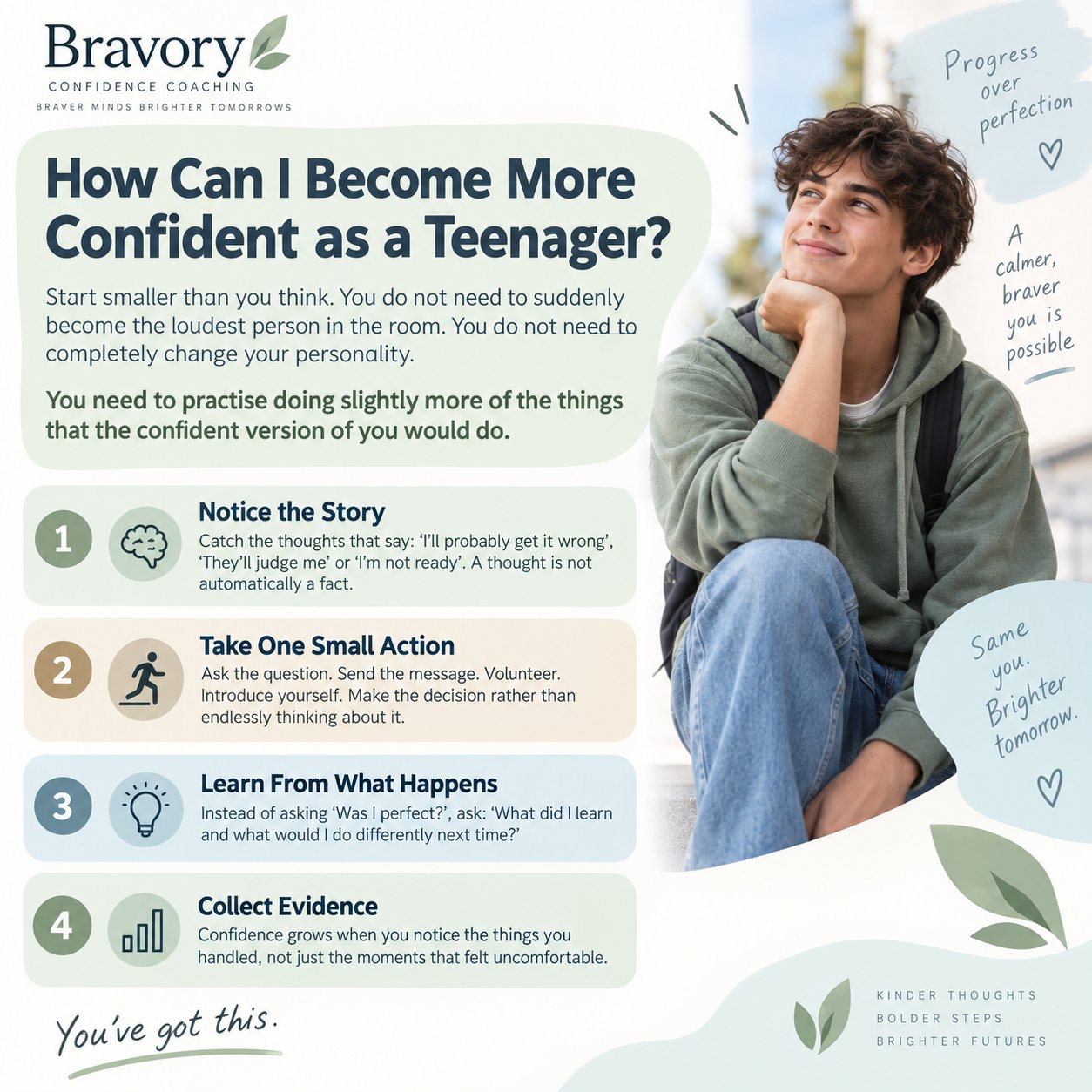
What Do Poor Decision-Making Skills Look Like in Teenagers?
A teenager who struggles to make decisions may not look indecisive all the time.
You may notice patterns such as:
Constantly Asking Others
“What would you do?” becomes the first response to almost every decision.
Second-Guessing
They make a choice, then immediately reopen the whole decision.
Putting Decisions Off
Delaying feels safer than choosing.
Fear of Regret
They want certainty that they will never wish they had chosen differently.
Following Friends
Going along with the group feels easier than deciding what they want themselves.
Overthinking
Every possible outcome gets analysed until even a simple decision feels enormous.
Fear of Disappointing People
They choose what they think parents, friends or teachers want rather than what makes sense to them.
Wanting Parents to Decide
They hand the final responsibility back because being responsible for the outcome feels uncomfortable.
Why Do Some Teenagers Struggle to Make Decisions?
There can be several reasons.
Sometimes they simply have not had enough practice.
Sometimes parents and adults have understandably made most important decisions for them.
Sometimes the issue is confidence.
Sometimes it is fear.
Common thoughts include:
- What if I make the wrong decision?
- What if I regret it?
- What if Mum or Dad think I've chosen badly?
- What if my friends disagree?
- What if everyone else knows something I don't?
- What if I fail?
- What if people judge me?
The teenager may not actually need more advice.
They may need more confidence in their ability to make the decision.
Why Decision-Making Is Such an Important Teen Life Skill
Teenagers are approaching a stage of life where the number of decisions increases quickly.
They may need to decide:
- GCSE or A-level options;
- college courses;
- university choices;
- apprenticeships;
- jobs;
- friendships;
- relationships;
- how to spend money;
- how to manage time;
- when to say yes;
- when to say no;
- how to respond to pressure;
- what sort of person they want to become.
Parents cannot realistically make every decision forever.
So decision-making needs to become a skill the young person gradually owns.
Decision-Making Is Part of Independence
You cannot become genuinely independent while somebody else still makes all your decisions.
Independence means gradually moving from:
“Tell me what to do.”
towards:
“I've thought about it. Here's what I think I'm going to do.”
That does not mean refusing advice.
Advice can be incredibly useful.
But advice and decision-making are different.
Advice gives you information.
Decision-making means deciding what you will do with it.
How to Make Decisions Confidently as a Teenager
When you feel stuck, use this practical Bravory decision-making process.
1. Define the Actual Decision
Overthinking often makes a decision bigger than it really is.
Write down one sentence:
“The decision I need to make is...”
For example:
“The decision I need to make is whether to apply for this Saturday job.”
Not:
“What am I doing with the rest of my life?”
Make the problem the correct size.
2. Identify Your Realistic Options
List the genuine choices.
Try not to create twenty imaginary possibilities.
Perhaps the options are:
- apply;
- don't apply;
- find out more before deciding.
Now you have something concrete to compare.
3. Work Out What Matters
Ask:
- What do I want?
- What matters most here?
- What are my priorities?
- What would I regret not trying?
- What fits the person I want to become?
This stops the decision being based entirely on what everybody else thinks.
4. Separate Facts From Predictions
A fact might be:
“The job is Saturday mornings.”
A prediction might be:
“I'll probably be terrible and everyone will think I'm useless.”
Those are not the same thing.
Make decisions using information, not just fear.
5. Think About Consequences
Ask:
- What could happen if I choose option A?
- What could happen if I choose option B?
- Which consequences are realistic?
- Which could I handle?
Remember that an unwanted consequence does not automatically mean the decision was terrible.
6. Decide Whether the Decision Is Reversible
This can reduce enormous amounts of pressure.
Ask:
“Can I change this later?”
Many decisions are adjustable.
You can leave a club.
Change a job.
Alter a plan.
Try another approach.
Not every choice determines the rest of your life.
7. Ask for Advice — After Thinking First
There is nothing wrong with talking to somebody you trust.
But instead of:
“What should I do?”
try:
“I've thought about this. These are my options. I'm leaning towards this because... What have I missed?”
Now you are still owning the decision.
8. Set a Decision Deadline
Without a deadline, overthinking can continue forever.
Give yourself an appropriate amount of time.
Small decision?
Maybe two minutes.
Medium decision?
Perhaps tonight.
Major education or career choice?
Gather the information you need, then set a reasonable date to decide.
9. Make the Decision
Eventually you have to choose.
You may still feel uncertain.
That is OK.
Confidence is not:
“I know with absolute certainty this is right.”
It can simply be:
“This makes the most sense with what I know right now.”
10. Stop Reopening It
Once you have reasonably decided, practise moving forward.
Constantly reopening a choice does not always improve it.
Tell yourself:
“I have decided. Now I will see what happens.”

The Bravory 6-Step Decision Check
For a decision you are currently struggling with, answer these six questions.
1. What exactly am I deciding?
2. What are my realistic options?
3. What facts do I know?
4. What am I only predicting?
5. Which option makes most sense to me?
6. When will I decide?
Then make the choice.
The final step matters.
A decision-making tool that simply creates another hour of thinking has missed the point.
Stop Looking for the Perfect Decision
Some teenagers struggle because they are trying to identify the choice that guarantees:
- no disappointment;
- no regret;
- no criticism;
- no mistakes;
- no awkwardness;
- and the perfect outcome.
That option often does not exist.
A better target is:
“What is the best reasonable decision I can make with the information available today?”
That is much closer to how real adult decisions work.
What If I Make the Wrong Decision?
You will eventually.
Every adult does.
You may choose something and later wish you had chosen differently.
That does not automatically mean you are bad at making decisions.
Ask:
- What did I know at the time?
- Was the decision reasonable?
- What have I learned since?
- Can I change anything?
- What will I do now?
Good decision-makers are not people who never make a poor decision. They are people who can learn, adjust and make the next one.
Teenagers Who Constantly Ask Parents What to Do
If your teenager repeatedly asks:
“What should I do?”
your instinct may be to answer.
After all, you probably know what you would do.
But if the objective is to develop decision-making confidence, try asking:
“What do you think?”
If they say:
“I don't know.”
try:
“What are your options?”
Then:
“Which one are you leaning towards?”
Then:
“Why?”
You can still provide advice.
But you are teaching them to think before receiving your answer.
Parents: Move From Decision-Maker to Thinking Partner
As teenagers grow, a useful shift happens.
When they are younger, parents understandably make most decisions.
Gradually, the role can move towards:
thinking partner.
Instead of:
“Here's what you should do.”
Try:
“What options do you think you have?”
Instead of:
“That's the wrong choice.”
Try:
“What do you think could happen if you choose that?”
Instead of:
“Leave it with me.”
Try:
“What part could you handle yourself?”
The goal is not to stop parenting.
It is to gradually transfer more thinking and responsibility to the teenager.
Allow Some Safe Decisions to Be Imperfect
Parents often spot poor choices before their teenager does.
Sometimes you need to intervene.
Safety comes first.
But where the consequences are manageable, there can be value in allowing some imperfect decisions.
If everything is corrected before it happens, the teenager loses the opportunity to learn:
decision → consequence → reflection → better decision.
Afterwards ask:
“Knowing what you know now, what would you do differently?”
That creates learning without humiliation.
Teen Decision-Making and Peer Pressure
Decision-making becomes harder when friends are involved.
The question stops being:
“What do I want to do?”
and becomes:
“What will everyone think if I don't?”
Before a pressured decision, ask:
- Would I choose this if nobody else were here?
- Do I actually want to do it?
- What could the consequences be?
- Will I be comfortable with this decision tomorrow?
- Am I choosing — or simply following?
Social confidence and decision-making are often closely connected.
Decision-Making and Fear of Failure
Sometimes you cannot decide because you are frightened that one option might fail.
But refusing to choose is still a choice.
Ask:
“Am I avoiding this decision because I need more information — or because I want a guarantee?”
If what you really want is certainty, more thinking may not create it.
You may need enough courage to decide without it.
Explore Fear of FailureDecision-Making and Overthinking
Overthinking can make even ordinary choices exhausting.
Should I send the message?
Should I choose this subject?
Should I go to the event?
What if I regret it?
What if something better happens?
When the same thoughts repeat without producing new information, set a decision deadline.
Thinking should eventually lead to:
decision → action → information.
Explore Teen Overthinking HelpHow to Make Big Education Decisions
Subject choices, college, university and apprenticeships can feel enormous.
Try breaking the decision down.
What genuinely interests me?
What am I reasonably good at?
What opportunities could this create?
What are the practical considerations?
What information am I missing?
Who could give me informed advice?
What do I think after hearing the advice?
Notice the final question.
Other people can provide information.
The young person still needs to be part of the decision.
How to Make Decisions About Jobs and Work
Young people entering work may need to choose:
- whether to apply;
- which jobs to consider;
- whether an apprenticeship is right;
- whether to accept an offer;
- whether to ask for more responsibility;
- whether to raise a concern;
- when it might be time to move on.
Useful questions include:
“What will I learn?”
“What does this opportunity give me?”
“What are the downsides?”
“What does my instinct say after looking at the evidence?”
A Simple Decision Matrix for Teenagers
For a difficult choice, create four headings:
Reasons For
What makes this option attractive?
Reasons Against
What disadvantages or risks exist?
What Matters Most
Which factors are genuinely important to me?
Next Step
What action would move the decision forward?
Not every item should have equal importance.
Ten small advantages may matter less than one major concern.
The 24-Hour Decision Experiment
Choose one decision that matters but is not life-changing.
Give yourself a deadline of 24 hours.
During that time:
- Define the decision.
- Identify your options.
- Gather only the information you genuinely need.
- Ask for one useful opinion if necessary.
- Make the decision.
- Do not reopen it unless genuinely new information appears.
Afterwards ask:
“What did I learn about trusting my judgement?”
The BRAVE Method and Decision-Making
B — Belief
Believe that your judgement deserves a place in the decision.
R — Resilience
Know that if a decision does not work perfectly, you can adjust and recover.
A — Action
Move from endless thinking into a reasonable choice and next step.
V — Voice
Ask questions, gather information and express what you want rather than simply following others.
E — Evidence
Remember decisions you have already made and situations you successfully handled.
Decision-Making Skills for Young Adults
These skills become increasingly important as teenagers move into adult life.
Young adults may need to decide:
- where to live;
- what work to pursue;
- whether to go to university;
- how to manage money;
- which relationships are healthy;
- what boundaries to set;
- what opportunities to take;
- what risks are sensible.
Parents and guardians can still be an important source of advice.
But the long-term objective is that the young adult can increasingly say:
“I've listened. I've thought. This is my decision.”
Take the Bravory Teen Confidence Scorecard
Decision-making rarely sits on its own.
Difficulty making choices may connect with:
- low self-belief;
- overthinking;
- fear of judgement;
- fear of failure;
- low resilience;
- communication difficulties;
- or lack of independence.
The Bravory Teen Confidence Scorecard explores self-belief, communication, resilience after setbacks, friendships and social courage, and readiness for independence. :contentReference[oaicite:2]{index=2}
Take the Teen Confidence ScorecardHow the Bravory 6-Week Programme Builds Decision-Making Confidence
Decision-making is already part of the Bravory confidence approach.
The 6-Week Teen Confidence Mastery Programme helps teenagers and young adults practise:
- making decisions without endless overthinking;
- understanding the inner critic;
- building self-belief;
- handling fear of getting things wrong;
- communicating confidently;
- developing resilience;
- becoming more independent;
- and taking action before everything feels certain.
The goal is not to create a young person who never asks for advice.
The goal is a young person who can listen to advice and still think for themselves.
Explore the 6-Week Teen Confidence ProgrammeExplore More Bravory Support
Teen Confidence Scorecard
Explore self-belief, communication, resilience, social courage and independence.
Take the ScorecardTeen Overthinking Help
Learn how to stop endlessly analysing choices and move towards useful action.
Explore Overthinking HelpYoung Adult Independence
Develop responsibility, decision-making and practical skills for adult life.
Explore Young Adult IndependenceFear of Failure
Learn how to make choices even when there is no guarantee everything will work perfectly.
Explore Fear of FailureCommunication Skills
Build the confidence to ask questions, gather information and express your choices.
Explore Communication SkillsTeen Resilience
Learn how to recover when a choice or plan does not work as expected.
Explore Teen ResilienceWhen Decision-Making Difficulties May Need Additional Support
Some indecision is completely normal.
Important decisions can feel difficult at any age.
Bravory focuses on confidence, communication, resilience, independence and practical life skills.
It is not therapy, counselling or mental-health treatment.
If decision-making difficulty is connected with severe anxiety, obsessive or compulsive behaviour, significant distress, depression, trauma, developmental needs or a major impact on everyday functioning, appropriate professional support may be useful.
Where appropriate, speak with a GP, school pastoral or safeguarding team, counsellor or suitably qualified healthcare or mental-health professional.
Frequently Asked Questions About Teen Decision-Making Skills
How can I help my teenager make decisions confidently?
Ask what they think before giving your answer. Help them identify their options, consider realistic consequences and decide what matters most. Give them opportunities to make age-appropriate choices and reflect afterwards rather than automatically deciding for them.
Why can't my teenager make decisions?
Possible reasons include limited practice, fear of making mistakes, overthinking, perfectionism, fear of judgement or becoming used to other people making decisions for them.
How can teenagers improve decision-making skills?
Practise making small decisions regularly, define the actual choice, identify realistic options, separate facts from predictions, consider likely consequences, ask for useful advice where necessary and set a reasonable deadline for deciding.
Should parents let teenagers make their own decisions?
Teenagers benefit from increasing age-appropriate decision-making responsibility. Parents still need to intervene where safety, safeguarding, legality or serious consequences are involved, but manageable choices can provide valuable practice.
How can my teenager stop second-guessing every decision?
Encourage them to decide what information is genuinely needed, set a decision deadline and avoid reopening a reasonable choice unless new information appears. Confidence grows through seeing what happens after decisions are made.
What if my teenager makes the wrong decision?
Where the consequences are manageable, use the experience for reflection. Ask what they knew at the time, what happened, what they learned and what they would do differently next time.
How is decision-making linked to confidence?
Each time a teenager makes a reasonable decision and deals with what happens next, they gain evidence that they can trust their judgement. That evidence can strengthen confidence and independence.
Does Bravory teach decision-making skills?
Yes. Decision-making is part of Bravory's confidence-building approach. The 6-Week Teen Confidence Mastery Programme helps young people make choices with less overthinking while developing self-belief, resilience, communication and independence.
Confidence Isn't Always Knowing What to Do
You will face decisions where two options both look good.
You will face decisions where neither option is perfect.
You will make decisions without all the information.
You will occasionally change your mind.
You will sometimes wish you chose differently.
That does not mean you are bad at decisions.
It means you are learning to make them.
Decision-making confidence is not knowing the future. It is trusting yourself enough to choose a direction and deal with what happens next.
Make One Decision for Yourself This Week
Choose something you would normally ask somebody else to decide.
Not something dangerous.
Not something with enormous consequences.
Just one real decision.
Ask:
What am I deciding?
What are my options?
What do I know?
What matters to me?
What makes most sense?
Then decide.
And instead of asking whether it was perfect, ask:
“What did I learn about trusting myself?”
That's how decision-making confidence starts to grow.
Explore the 6-Week Teen Confidence Programme Take the Teen Confidence Scorecard