Does “What Will People Think?” Make Too Many of Your Decisions?
Imagine somebody asks:
“What do you want to do?”
What happens inside your head?
Do you genuinely think about what you want?
Or does your brain immediately start checking the imaginary audience?
- Will my friends think it's weird?
- Will people laugh?
- What if I get it wrong?
- Will people think I'm showing off?
- What if nobody else is doing it?
- Will I look stupid?
- What if someone makes a comment?
- What if I say something embarrassing?
- What if people don't like me afterwards?
If you recognise that, the real issue may not be that you don't know what you want.
It may be that fear of other people's judgement has become louder than your own voice.
Fear of Judgement Doesn't Always Look Like Fear
You don't necessarily have to look nervous or shy.
Sometimes worrying about other people's opinions looks like:
Staying Quiet
You know what you want to say, but decide saying nothing feels safer.
Changing Your Opinion
You agree with the group even though privately you think something different.
Overthinking
You replay messages and conversations because you're worried about how you came across.
Trying to Fit In
You change what you wear, like, say or do because standing out feels risky.
Avoiding Opportunities
You secretly want to try something but decide not to because people might notice you.
Constant Reassurance
You keep checking whether other people think your choice, idea, appearance or answer is OK.
Why Do I Care So Much About What Other People Think?
Because you're human.
Wanting to belong is not a weakness.
Friendships matter. Acceptance matters. How people treat us matters.
During the teenage years, friendships, social groups, appearance and identity can suddenly feel far more important.
The problem isn't that you care what anybody thinks.
The problem is when you begin giving everybody's opinion more power than your own.
The question isn't:
“How do I stop caring what anybody thinks?”
A better question is:
“How do I stop letting fear of judgement control what I do?”
The Imaginary Audience in Your Head
Sometimes the person judging you isn't even actually judging you.
You are predicting what they might think.
For example:
Fact: “I'm thinking about joining the drama group.”
Your brain adds:
“People will think that's weird.”
“Everyone will laugh.”
“My friends will take the mickey.”
But have they actually said any of those things?
Or have you predicted them?
Other people's imaginary opinions shouldn't automatically be allowed to make your real-life decisions.
How to Stop Worrying What People Think as a Teenager
You probably won't wake up tomorrow and suddenly stop caring.
That's not the aim.
Instead, start learning how to reduce the amount of power those thoughts have.
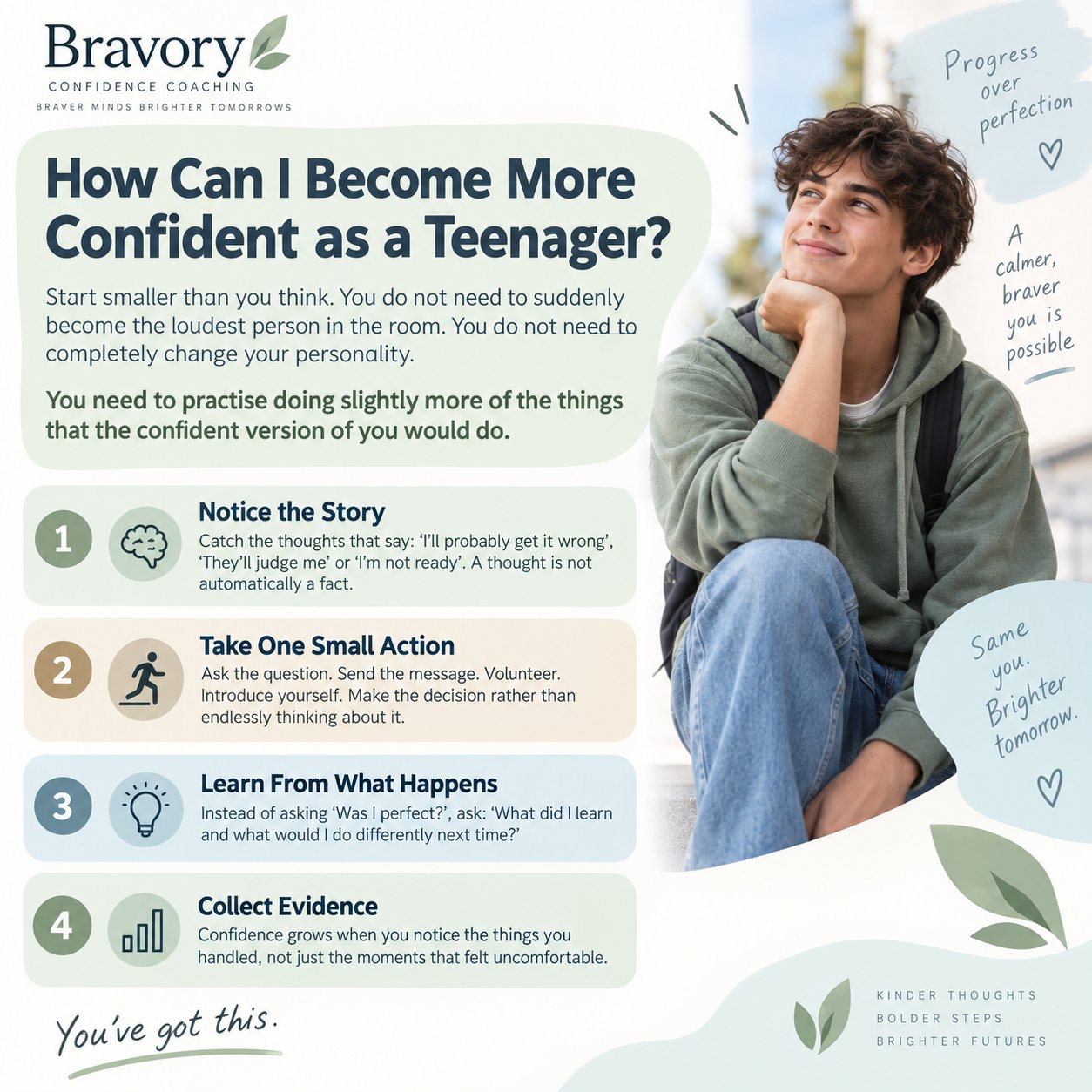
1. Catch the Question
Notice when your first thought is:
“What will everyone think?”
You don't have to fight the thought.
Just recognise that it is there.
2. Ask: “How Do I Know?”
Suppose you think:
“Everyone will think I'm stupid.”
Ask:
“How do I actually know that?”
Is there evidence?
Or are you trying to read people's minds?
3. Ask Yourself What YOU Think
This sounds simple.
But if you are used to checking everyone else's opinion first, your own opinion can become very quiet.
Before asking friends:
“What should I do?”
ask yourself:
“What do I think I should do?”
4. Decide Whose Opinion Deserves Weight
Not every opinion is equally useful.
Ask:
- Does this person know me?
- Do they want the best for me?
- Do I respect their judgement?
- Would I ask this person for advice?
- Do they understand the situation?
If the answer is no, why are you allowing their possible opinion to control your choice?
5. Practise One Small Act of Individuality
You don't need to make some enormous statement about being yourself.
Start smaller.
- Say which film you actually want to watch.
- Choose what you genuinely like.
- Give your real opinion.
- Ask the question.
- Wear something because you like it.
- Suggest something to your friends.
- Say no when you genuinely don't want to do something.
Every small choice teaches your brain:
“My opinion counts too.”
6. Learn to Tolerate Disagreement
Someone disagreeing with you doesn't automatically mean you're wrong.
Two people can look at the same thing and have different opinions.
That's normal.
Confidence doesn't mean everybody agrees with you.
Confidence means you don't immediately abandon yourself when they don't.
7. Take a Small Social Risk
You build confidence through evidence.
Try something where you may be noticed.
Keep it manageable.
- Put your hand up once.
- Introduce yourself.
- Speak to somebody unfamiliar.
- Volunteer for something.
- Share an idea.
- Answer the question.
Then notice what actually happens rather than what you predicted would happen.
8. Let an Awkward Moment Be Awkward
You will occasionally say something that comes out wrong.
You might stumble over a word.
Tell a joke that nobody hears.
Walk into the wrong room.
Get an answer wrong.
That's life.
Confidence isn't avoiding embarrassment forever.
It's learning:
“That was awkward. I'm still OK.”

Try the “Whose Opinion?” Test
Next time you find yourself worrying what someone thinks, ask yourself five questions.
1. Who exactly am I worried about?
2. What do I think they might think?
3. Do I actually know that's what they think?
4. Do I genuinely respect this person's opinion?
5. What would I choose if I knew I could handle them disagreeing?
That final question can be powerful.
It moves your thinking away from:
“How do I make sure nobody judges me?”
towards:
“What would I choose if judgement didn't have to control me?”
What If People Actually DO Judge Me?
This matters, because saying:
“Nobody is judging you.”
isn't always true.
Sometimes people will have an opinion.
Someone may dislike your clothes.
Someone may disagree with what you say.
Someone may think your hobby is strange.
Someone may make an unkind comment.
The confidence question isn't:
“How can I guarantee nobody ever judges me?”
You can't.
The more useful question is:
“Can I learn to be OK even when somebody doesn't approve?”
That's a very different kind of confidence.
Stop Trying to Win a Vote That Isn't Happening
Fear of judgement can make life feel as though you're constantly standing for election.
Did they like what I said?
Did they like what I wore?
Did I look confident?
Was I funny enough?
Did they think I was clever?
Was that message OK?
Did I fit in?
But most people are spending far more time thinking about themselves than conducting a detailed review of you.
And even when somebody does have an opinion, you don't automatically have to turn it into a verdict.
An opinion is information. It isn't automatically an instruction.
Social Media Can Make Approval Feel Measurable
Likes.
Views.
Comments.
Followers.
Read receipts.
Social media can make it feel as though approval has a number attached to it.
You may start wondering:
- Why didn't they like my post?
- Why did more people like theirs?
- Should I delete this?
- Does this photo look good enough?
- What if nobody responds?
Try asking:
“Would I still like this if nobody else could see it?”
or:
“Am I sharing this because I want to, or because I want proof that people approve?”
There isn't always a right or wrong answer.
The point is to notice.
What If My Friends Judge Me?
Friendships matter enormously when you're a teenager.
So saying:
“Just ignore what your friends think.”
isn't particularly realistic.
But healthy friendships should leave some space for you to be yourself.
Ask yourself:
- Can I disagree with my friends?
- Can I say no?
- Can I like something they don't?
- Can I spend time with other people?
- Can I admit I don't know something?
- Can I make a mistake without being humiliated?
- Can I be myself without constantly performing?
You shouldn't need to pass an audition every day to keep a friendship.
Are You Being Kind — or People-Pleasing?
There is nothing wrong with caring about other people's feelings.
Kindness matters.
But being kind and trying to keep everybody happy are not the same thing.
Kindness
“I care how my behaviour affects other people.”
People-Pleasing
“I need everybody to approve of me before I feel OK.”
Respect
“I will listen to what you think.”
Approval-Seeking
“I will change what I think so you don't disagree with me.”
You can be thoughtful, respectful and kind without handing everyone else control of your choices.
The Bravory Approach: Build an Internal Voice
At Bravory, the aim isn't to teach teenagers to stop caring about everybody.
It's to help you build enough self-belief that other people's opinions aren't always louder than your own.
That's part of the BRAVE Method.
B — Belief
Learn to recognise your own strengths and question the story that says other people's judgement defines you.
R — Resilience
Discover that disagreement, embarrassment, criticism and rejection can be uncomfortable without destroying your confidence.
A — Action
Take small brave actions before you have complete certainty that everybody will approve.
V — Voice
Develop the confidence to express what you think, ask questions, say no and communicate clearly.
E — Evidence
Notice the times you were yourself, took the risk or spoke up — and handled what happened afterwards.
Take the Bravory “Am I Too Worried About What People Think?” Check
Sometimes you don't realise how much other people's opinions influence you until you start looking at your everyday choices.
The Bravory self-reflection activity can help you explore:
- How much you change yourself to fit in
- Whether fear of judgement stops you speaking up
- How much reassurance you need
- Whether social comparison affects your confidence
- Whose opinions influence you most
- And what one small brave action could look like
Change this link if your live Bravory quiz uses a different URL.
A Challenge: The 10% More You Experiment
You don't need to suddenly stop caring what everyone thinks.
Try something smaller.
Ask yourself:
“What would I do differently this week if I cared 10% less about being judged?”
Would you:
- Speak once in class?
- Wear something you genuinely like?
- Give your actual opinion?
- Message someone first?
- Join something?
- Apply for something?
- Say no?
- Ask for help?
- Share an idea?
Pick one.
Then pay attention to what actually happens.
That becomes evidence.
How Parents Can Help a Teenager Who Is Scared of Being Judged
If you are reading this as a parent or guardian, it can be frustrating watching a capable young person hold back because of what other people might think.
Try not to begin with:
“Who cares what people think?”
Your teenager probably does.
Instead try:
- “What exactly are you worried they might think?”
- “How do you know that's what they'll think?”
- “What do you think?”
- “Whose opinion matters most here?”
- “What would you choose if nobody else knew?”
- “If somebody disagreed, could you handle that?”
- “What's one small step you could take anyway?”
The objective isn't to talk your teenager out of every uncomfortable feeling.
It's to help them discover:
“I can feel self-conscious and still do things.”
Bravory also has a dedicated parent guide:
Read the Parent GuideTurn Understanding Into Action With the 6-Week Programme
Reading about fear of judgement can help you understand what is happening.
But confidence develops when you practise doing things differently.
The Bravory 6-Week Teen Confidence Mastery Programme helps teenagers and young adults work on:
- Self-belief
- Fear of judgement
- Overthinking
- Speaking up
- Making decisions
- Social confidence
- Resilience
- Independence
- The inner critic
- And taking action even when something feels uncomfortable
The aim isn't to simply understand confidence.
It's to practise it.
Explore the 6-Week Confidence Programme
Explore More Bravory Confidence Tools
Teen Confidence Test
Explore self-belief, social confidence, communication, resilience and independence.
Take the Confidence TestDo I Overthink Everything?
Explore whether second-guessing and overthinking are making confidence harder.
Take the Overthinking CheckParent Hub
Practical guidance for parents who want to help teenagers develop confidence without constantly stepping in.
Explore the Parent HubTeen & Young Adult Hub
Articles, challenges and practical tools designed for teenagers and young adults.
Explore the Teen HubConfidence Building for Teens
Discover practical ways to build confidence through small actions and real experiences.
Read the Guide6-Week Confidence Programme
Turn confidence ideas into real-life action through a structured six-week programme.
Explore the ProgrammeWhen Fear of Judgement May Need Additional Support
Being self-conscious and worrying about other people's opinions can be part of growing up.
But sometimes fear of judgement becomes much more intense.
If fear of being judged is causing significant distress, preventing you from attending school or college, making friendships extremely difficult, leading to severe avoidance or significantly affecting everyday life, it may be useful to speak to an appropriate professional.
Bravory provides confidence, communication, resilience and personal development training.
Bravory is not therapy or mental-health treatment.
Where appropriate, speak with a parent or guardian, GP, school pastoral or safeguarding team, counsellor or qualified mental-health professional.
Frequently Asked Questions About Fear of Judgement in Teenagers
Why do I care so much about what people think as a teenager?
Belonging, friendship and identity can feel particularly important during the teenage years. Caring what people think is normal. The difficulty starts when fear of judgement repeatedly stops you speaking, participating, making your own choices or being yourself.
How do I stop worrying what people think?
Start by noticing when you are predicting other people's opinions, ask what evidence you actually have, decide whose opinions genuinely matter and practise taking small actions based on what you think rather than always seeking approval.
How can I stop being scared of being judged?
You cannot guarantee that nobody will ever judge you. Instead, build confidence by taking manageable social risks and learning that disagreement, attention and occasional awkward moments are things you can handle.
How do I stop seeking approval from friends?
Practise forming your own opinion before asking other people, make small independent choices and notice when you are changing what you want purely to avoid disagreement.
Is caring what other people think bad?
No. Caring about how our behaviour affects people and valuing the opinions of people we trust can be healthy. The aim is not to stop caring completely, but to stop giving every possible opinion control over your choices.
Can confidence help with fear of judgement?
Yes. Greater self-belief can make it easier to express opinions, make choices and take action when other people's approval is uncertain. Confidence is not knowing nobody will judge you; it is trusting yourself to handle it if they do.
How can parents help a teenager who worries what people think?
Listen rather than dismissing the fear. Ask what the teenager thinks others might say, what evidence they have and what they would choose themselves. Encourage manageable opportunities to express opinions, make choices and tolerate disagreement.
You Don't Have to Become Someone Who Doesn't Care
This isn't about becoming cold.
It's not about ignoring good advice.
And it's definitely not about deciding that nobody else's feelings matter.
It's about balance.
Listen to people you respect.
Be kind.
Be willing to learn.
Accept useful feedback.
But remember:
Other people can have an opinion about your life without automatically getting to make your decisions.
Your voice deserves to be in the conversation too.
What Would You Do If You Trusted Yourself 10% More?
Don't try to change everything today.
Think of one thing you've been avoiding because you're worried what people might think.
Then ask:
“What would I do if I trusted myself just 10% more?”
Speak.
Ask.
Try.
Choose.
One small brave action creates evidence for the next one.
Explore the 6-Week Teen Confidence Programme Take the Fear of Opinions Check