The Biggest Problem With Overthinking Isn't Thinking
Thinking things through can be useful.
The problem starts when thinking stops helping you make a decision and starts preventing you from making one.
You might recognise the pattern:
- You need to send a message, but rewrite it five times.
- You think about speaking in class, then decide not to.
- You agree to something and immediately wonder whether you made the wrong choice.
- You replay something you said hours or even days later.
- You worry that someone is annoyed with you because their reply seemed different.
- You imagine every possible outcome before trying something new.
- You ask several people what they think because you don't trust your own judgement.
- You put off making a decision until somebody else effectively makes it for you.
It can feel as though you are being careful.
But sometimes overthinking becomes a clever way of avoiding the possibility of being wrong.
If you're waiting until you are 100% certain before taking action, you may be waiting a very long time.
What Does Overthinking Feel Like as a Teenager?
Overthinking isn't always obvious to other people.
From the outside, you might look quiet, careful or indecisive.
Inside, your mind can feel very different.
Replaying Conversations
“Why did I say that?”
“Did that sound stupid?”
“Do they think I'm weird?”
Second-Guessing Decisions
“What if I picked the wrong thing?”
“What would everyone else choose?”
“Should I change my mind?”
Predicting the Worst
“What if it goes badly?”
“What if nobody talks to me?”
“What if I embarrass myself?”
Worrying About Opinions
“What will people think?”
“Will they judge me?”
“What if they don't like me?”
Trying to Get Everything Perfect
You delay starting because you are trying to work out the perfect way to do it first.
Needing Reassurance
You keep asking other people whether your choice, message, outfit, answer or idea is OK.
Why Do Teenagers Overthink?
There is no single reason.
Teenage life involves a lot of uncertainty.
Friendships change. School becomes more demanding. Exams matter. Social situations can feel complicated. You may be thinking about college, university, apprenticeships, work, relationships and who you want to become.
At the same time, it can feel as though everybody is watching.
That combination can create thoughts like:
- What if I make the wrong choice?
- What if everyone else knows what they're doing except me?
- What if people judge me?
- What if I fail?
- What if I regret it?
- What if I say something embarrassing?
So your brain tries to protect you by thinking through every possibility.
The problem is that there are some things you simply cannot know in advance.
The goal isn't to think about every possible outcome.
The goal is to think enough to make a reasonable decision — and then trust yourself enough to act.
Are You Thinking — or Overthinking?
There is a useful difference.
Useful Thinking
“What information do I need?”
“What are my realistic options?”
“What is the next step?”
“What can I learn?”
Overthinking
“What if this happens?”
“But what if that happens after that?”
“What will everyone think?”
“What if I'm wrong?”
“What if I regret it forever?”
Useful thinking usually moves you towards action.
Overthinking often takes you around the same circle again and again.
How to Stop Overthinking as a Teenager
You probably cannot command your brain to “stop thinking”.
And trying not to think about something can sometimes make you think about it even more.
Instead, the aim is to learn what to do when you notice yourself getting stuck.
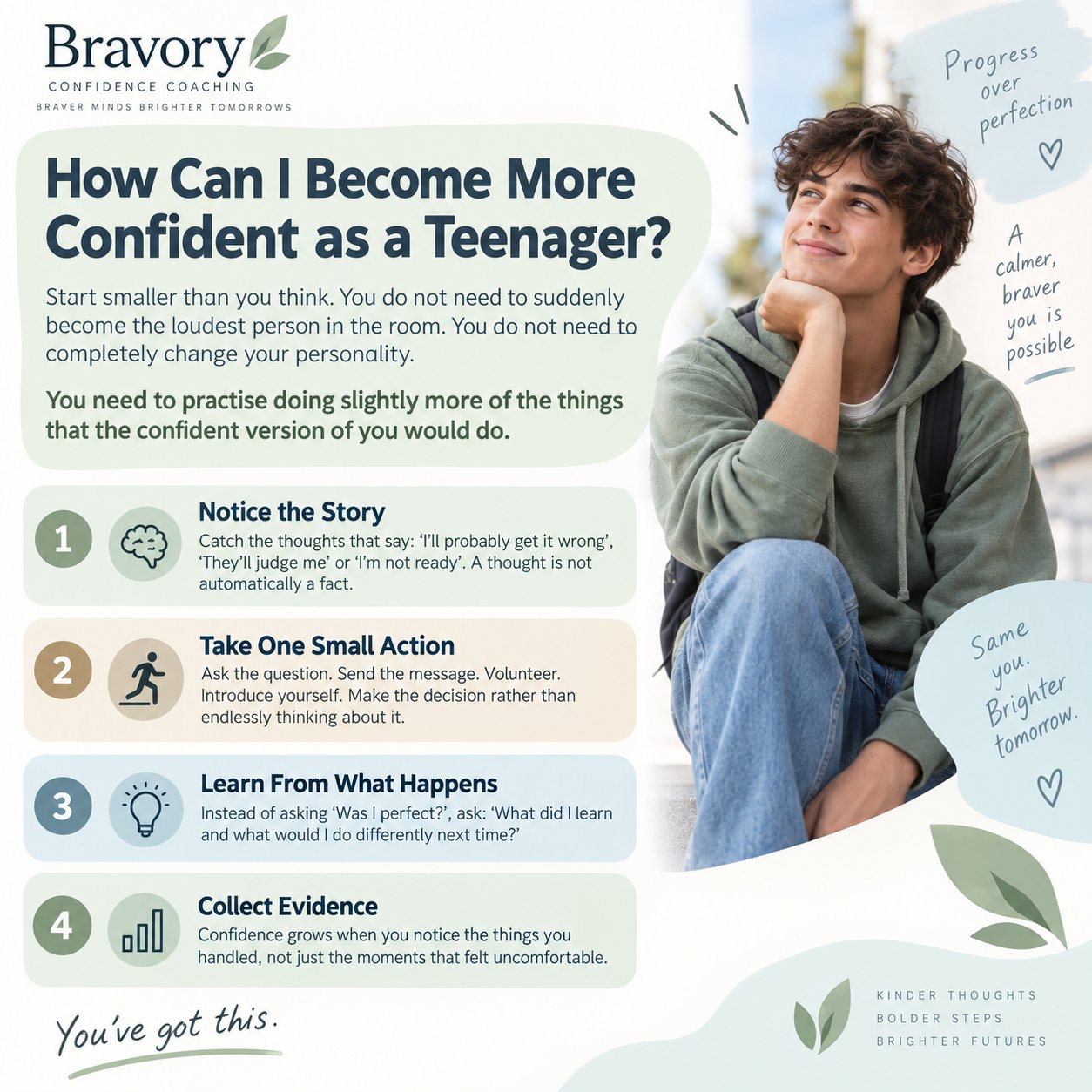
1. Catch Yourself Overthinking
Before you can change a pattern, you need to notice it.
Try saying:
“I'm not solving this anymore. I'm going around in circles.”
Simply recognising what is happening gives you a chance to choose what happens next.
2. Get the Thoughts Out of Your Head
If your mind feels crowded, write down what you are thinking.
Use paper or the notes app on your phone.
Don't try to make it perfect.
Write:
- What am I worried about?
- What do I think might happen?
- What do I actually know?
- What am I guessing?
Sometimes seeing the thought written down makes it easier to examine rather than simply believe it.
3. Ask: “Is This a Fact or a Prediction?”
Imagine you sent somebody a message and they haven't replied.
The fact might be:
“They haven't replied for two hours.”
The overthinking version might become:
“I've annoyed them. They're ignoring me. They don't want to be friends anymore.”
Those things might feel real.
But they are predictions, not facts.
4. Ask: “Can I Do Anything About This?”
Some problems need action.
Others are questions your brain wants answered even though there is no answer available yet.
Ask yourself:
“Is there something useful I can do about this right now?”
If yes, decide the next step.
If no, continuing to think about it probably won't create any new information.
5. Give Decisions a Time Limit
Not every decision deserves hours of thought.
Try giving yourself a reasonable deadline.
For example:
- Small decision — 2 minutes.
- Moderate decision — 10 or 15 minutes.
- Bigger decision — gather the information you genuinely need, then choose a time when you will decide.
The aim isn't to rush.
It's to stop endlessly reopening a decision that has already had enough thought.
6. Choose “Good Enough” Sometimes
Perfectionism and overthinking often work together.
The message.
The homework.
The outfit.
The answer.
The presentation.
Sometimes it does not need to be perfect.
It just needs to be good enough to move forward.
7. Take One Small Action
Overthinking grows when everything stays inside your head.
Action gives you information.
Send the message.
Ask the question.
Try the activity.
Introduce yourself.
Make the decision.
Apply for the opportunity.
You can think about whether you can handle something for hours — or take one small step and start finding out.
8. Stop Reopening Decisions
Once you have made a reasonable decision, practise leaving it alone.
You can tell yourself:
“I made the best decision I could with the information I had. Now I'm going to see what happens.”
You are allowed to learn later.
You do not have to predict everything now.
9. Do Something That Brings You Back Into the Present
Overthinking often lives in the past or the future.
You are replaying something that has already happened or predicting something that hasn't happened yet.
Do something physical or absorbing:
- Walk;
- Exercise;
- Sport;
- Music;
- Drawing;
- Cooking;
- Talking with someone;
- Or another activity that requires your attention.
You are not pretending the problem does not exist.
You are giving your mind somewhere else to go for a while.

Try the 10-10-10 Overthinking Question
When something feels huge, ask yourself:
Will this matter in...
10 minutes?
10 days?
10 months?
Not every problem disappears when you ask this.
But it can help you work out whether your brain is treating a small moment like a permanent disaster.
What If I Keep Replaying Conversations?
This is one of the most common forms of overthinking.
You get home and suddenly remember something you said.
Then the investigation begins.
“Why did I say that?”
“Did they think that was weird?”
“I should have said something different.”
Try asking:
- What evidence do I actually have that something went wrong?
- Would I judge somebody else this harshly for saying the same thing?
- Am I expecting myself to communicate perfectly?
- Is there anything useful I need to do now?
If there is something useful to do, do it.
If there isn't, repeating the conversation for the 27th time probably won't improve it.
What If I'm Scared of Making the Wrong Decision?
This can be one of the biggest reasons teenagers and young adults overthink.
You may believe confident people always know what the right decision is.
They don't.
Confidence is often being able to make a reasonable choice without having a guarantee.
Instead of asking:
“What is the perfect decision?”
try:
“Which option makes most sense with what I know right now?”
Then decide.
If it turns out not to be the best decision, you adjust.
That is not failure.
That is how decision-making gets better.
What If I'm Constantly Worried About What Other People Think?
Overthinking and fear of other people's opinions often arrive together.
You might ask yourself:
- Will they laugh?
- Will I look awkward?
- What if they don't agree?
- What if they think I'm boring?
- What if I stand out?
There is an uncomfortable truth here:
You cannot control everybody else's opinion of you.
And if you organise your whole life around avoiding judgement, other people effectively get a vote on almost every decision you make.
Confidence isn't making everyone approve of you. It is becoming more comfortable making choices without needing everyone to approve.
The Bravory Way: Move From Thoughts to Evidence
At Bravory, we don't tell teenagers to simply “stop overthinking”.
That isn't particularly useful.
Instead, we help young people understand what their thoughts are doing and then practise moving towards useful action.
This is part of the BRAVE Method.
B — Belief
Notice the story you are telling yourself and question whether it is actually true.
R — Resilience
Learn that a wrong decision, awkward moment or setback does not define you.
A — Action
Stop waiting for complete certainty and take one manageable next step.
V — Voice
Say what you think, ask questions and communicate rather than endlessly rehearsing everything internally.
E — Evidence
Notice the decisions, conversations and situations you handled so your brain has real evidence to work with next time.
Overthinking Often Shrinks When You Start Collecting Evidence
Imagine you are nervous about introducing yourself to somebody.
Your brain can spend twenty minutes predicting what could happen.
Or you can say:
“Hi, I'm...”
Now you have evidence.
Maybe the conversation goes brilliantly.
Maybe it is ordinary.
Maybe it is slightly awkward.
But something very important has happened.
You survived not knowing exactly what would happen.
That is how confidence begins to grow.
A 60-Second Bravory Overthinking Challenge
Think about one thing you are currently overthinking.
1. What is the actual decision or problem?
2. What facts do I know?
3. What am I only predicting?
4. What is within my control?
5. What is one small action I can take?
6. When will I take it?
The final question matters.
Without action, an overthinking exercise can simply become another thing to think about.
Take the Bravory “Do I Overthink Everything?” Check
Sometimes it is difficult to recognise your own thinking patterns until somebody asks the right questions.
The Bravory Do I Overthink Everything? activity can help you explore:
- how often you second-guess yourself;
- whether fear of mistakes affects your decisions;
- whether you replay conversations;
- whether other people's opinions influence your choices;
- and what one practical next step might look like.
Change the link above if your live Bravory overthinking activity uses a different URL.
How Parents Can Help a Teenager Who Overthinks
If you are reading this because your teenager overthinks everything, it can be tempting to provide reassurance every time they become unsure.
Sometimes reassurance is helpful.
But if every difficult decision ends with:
“Mum, what should I do?”
or:
“Dad, do you think this is right?”
there is another skill they need to develop:
trusting their own judgement.
Instead of immediately answering, try asking:
- “What do you think?”
- “What are your realistic options?”
- “What evidence do you have?”
- “Which part can you control?”
- “What feels like the most sensible next step?”
- “If it doesn't work, what could you do then?”
The message becomes:
“I'm here to support you — and I also believe you can learn to think this through.”
From Overthinking to Taking Action: The 6-Week Programme
Knowing that you overthink is useful.
But awareness on its own does not change much.
The next stage is practice.
The Bravory 6-Week Teen Confidence Mastery Programme helps teenagers and young adults work on areas including:
- Understanding the inner critic
- Making decisions with less second-guessing
- Building self-belief
- Speaking up
- Handling fear of judgement
- Developing resilience
- Taking action before everything feels perfect
- And collecting evidence of progress
It includes practical learning and the 30-Day Confidence Building Challenge so confidence is practised in real life rather than simply read about.
Explore the 6-Week Confidence Programme
Explore More Bravory Support
Teen Confidence Test
Explore your current confidence across self-belief, communication, resilience, independence and social confidence.
Take the Confidence TestTeen & Young Adult Hub
Practical articles and tools to help with confidence, decisions, communication and becoming more independent.
Explore the Teen HubParent & Guardian Hub
Support for parents who want to help without constantly stepping in and taking over.
Explore Parent SupportConfidence Building for Teens
Discover practical ways teenagers can start building confidence through manageable action.
Read the Confidence Guide6-Week Programme
Turn understanding into practical confidence-building habits and real-world action.
Explore the ProgrammeContact Bravory
Not sure where to begin? Start a conversation about the type of support that might be suitable.
Contact BravoryWhen Overthinking May Be More Than a Confidence Issue
Everybody worries or overthinks sometimes.
Bravory focuses on confidence, communication, resilience, self-belief and practical personal development.
It is not therapy or mental-health treatment.
If thoughts or worries are becoming overwhelming, significantly affecting sleep, school, college, relationships or everyday life, or are connected with severe anxiety, depression, self-harm, trauma or concerns about safety, speak with an appropriate qualified professional.
That might include a GP, counsellor, school safeguarding or pastoral team, or specialist mental-health service.
Frequently Asked Questions About Teen Overthinking
How do I stop overthinking as a teenager?
Start by noticing when thinking has stopped being useful. Write the concern down, separate facts from predictions, identify what is actually within your control and choose one practical next action rather than continuing to mentally repeat the problem.
Why do I overthink everything?
Overthinking can happen when you feel uncertain, fear making mistakes, worry about other people's opinions or feel pressure to make the perfect choice. It can become a habit when your brain keeps searching for certainty that simply is not available.
How can I stop replaying conversations?
Ask yourself whether there is genuine evidence that something went wrong and whether there is anything useful you need to do now. If not, deliberately move your attention towards an activity in the present rather than continuing to rehearse the conversation.
Why do I second-guess every decision?
You may be trying to remove all possibility of regret or failure before choosing. Practise making smaller decisions within a reasonable time and allowing yourself to learn afterwards rather than expecting perfect certainty beforehand.
Can confidence help with overthinking?
Greater self-trust can make decisions easier because you become less dependent on certainty and reassurance. Confidence does not mean knowing every answer; it means believing you can deal with what happens next.
How can parents help teenagers who overthink?
Listen, avoid dismissing their worries and resist solving every decision immediately. Ask questions that help the teenager identify facts, options and a next step so they gradually develop confidence in their own judgement.
You Don't Need to Have Everything Figured Out
You are a teenager.
You are not supposed to have every answer.
You will make decisions you later change.
You will sometimes say something awkward.
You will occasionally get things wrong.
So will every adult you know.
The aim isn't to build a life where you never make the wrong choice.
The aim is to become somebody who trusts themselves enough to make a choice, learn from what happens and keep moving.
You don't need to know the whole path before taking the next step.
Less Overthinking. More Doing.
If you're tired of questioning every decision, replaying conversations and waiting until everything feels completely safe, start small.
Pick one thing you've been overthinking.
Ask yourself:
“What is one useful thing I can do next?”
Then do that.
One decision. One conversation. One small act of courage at a time.
Start the 6-Week Confidence Programme Take the Overthinking Check