The Quick Answer: How Can Parents Improve a Teenager's Confidence?
You cannot simply give confidence to your teenager.
But you can help create the conditions in which confidence grows.
That usually means:
- listening before fixing;
- giving them opportunities to make decisions;
- encouraging manageable challenges;
- letting them do more for themselves;
- praising courage, effort and recovery rather than only results;
- helping them put setbacks into perspective;
- encouraging them to speak for themselves;
- and reminding them of evidence of what they have already handled.
Confidence grows when a teenager increasingly discovers: “I can handle more than I thought.”
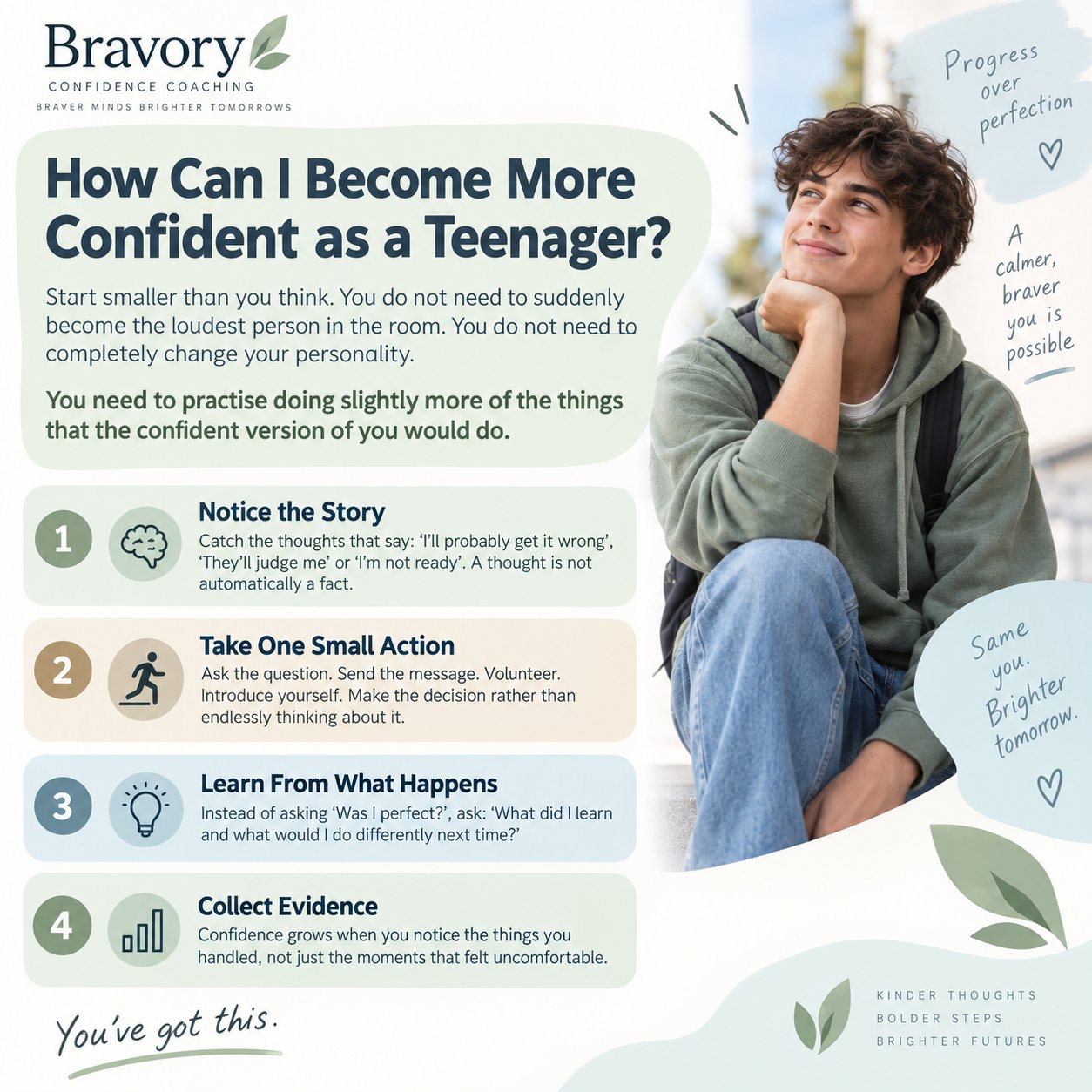
What Does Low Confidence Look Like in Teenagers?
Low confidence does not always look like shyness.
Some teenagers who lack confidence appear loud, funny or completely unconcerned.
Look for patterns rather than one behaviour.
They Avoid Trying
Opportunities are refused before they discover whether they could succeed.
They Put Themselves Down
“I'm useless”, “I can't do it” or “Everyone else is better than me” becomes normal language.
They Overthink
Simple decisions and conversations become mentally exhausting.
They Need Reassurance
They repeatedly ask whether something is right, whether they should do it or what you would do.
They Fear Mistakes
Being wrong feels like evidence that they are not good enough.
They Stay Quiet
They may know the answer or have an opinion but do not trust themselves enough to say it.
They Compare Constantly
Other people's confidence, appearance, results or friendships become evidence against themselves.
They Give Up Quickly
The first difficulty becomes a reason to stop.
Why Has My Teenager Lost Confidence?
Sometimes parents say:
“They used to be so confident.”
Teenage life introduces a lot of comparison.
Academic results.
Friendship groups.
Appearance.
Sport.
Social media.
Relationships.
Future choices.
A young person may suddenly become much more aware of how they compare with everyone around them.
Confidence can also be affected by:
- friendship difficulties;
- bullying;
- rejection;
- academic pressure;
- fear of failure;
- perfectionism;
- negative self-talk;
- major changes;
- feeling different;
- repeated criticism.
Understanding what is underneath the loss of confidence matters more than simply trying to make them appear confident.
Confidence Does Not Mean Becoming Loud or Extroverted
A quiet teenager does not automatically have low confidence.
An introverted teenager does not need fixing.
Confidence is better understood as having enough belief in yourself to:
- express your view;
- ask questions;
- try something new;
- make decisions;
- handle mistakes;
- meet people;
- say no when necessary;
- recover after setbacks.
Your teenager does not need to become the loudest person in the room.
They need enough confidence to have choices.
12 Practical Ways to Improve Your Teenager's Confidence
1. Listen Before You Fix
When your teenager tells you something difficult, your instinct may be to solve it immediately.
Try starting with:
“Tell me more.”
Or:
“Do you want me to listen, help you think it through, or help you decide what to do?”
Sometimes being understood is the first step towards confidence.
2. Stop Saying “Just Be Confident”
If they knew how, they probably would.
Turn confidence into behaviour.
Instead of:
“Be more confident.”
try:
“What's one small thing you could do?”
3. Let Them Speak for Themselves
Notice how often you answer for your teenager.
At restaurants.
Appointments.
School.
Shops.
Family conversations.
Sometimes it is easier and quicker to step in.
But where appropriate, give them space.
Communication confidence needs practice.
4. Encourage Small Brave Actions
Do not begin with the biggest thing they fear.
Confidence can start with:
- asking one question;
- sending one message;
- making one phone call;
- joining one activity;
- giving one opinion;
- applying for one opportunity.
Small successes become evidence.
5. Praise Courage, Not Just Results
Instead of only:
“Well done, you got an A.”
notice:
- preparation;
- effort;
- asking for help;
- trying again;
- speaking up;
- handling disappointment;
- doing something despite nerves.
Try:
“I know you were nervous about that. I noticed you still did it.”
6. Let Them Make More Decisions
Decision-making builds confidence.
Ask:
“What do you think?”
before:
“Here's what I think you should do.”
Give advice where useful.
But let their judgement have a place in the conversation.
7. Allow Safe Mistakes
This is difficult for parents.
You can sometimes see the mistake coming.
But age-appropriate mistakes can teach:
decision → consequence → reflection → learning.
Where it is safe to do so, resist automatically removing every possibility of getting something wrong.
8. Don't Compare Them With Other Teenagers
Even well-meaning comparison can create pressure.
Avoid:
“Your sister never struggled with this.”
Or:
“Look how confident your friend is.”
Compare their progress with their own starting point.
9. Help Them Challenge the Inner Critic
When your teenager says:
“I'll be terrible.”
do not immediately argue:
“No you won't.”
Try:
“What makes you think that?”
Then:
“What evidence do you have on the other side?”
The aim is to help them think differently, not simply borrow your reassurance.
10. Help Them Build Independence
Confidence grows when young people increasingly manage:
- appointments;
- money;
- travel;
- phone calls;
- deadlines;
- personal admin;
- their own decisions.
Every responsibility successfully handled becomes evidence of capability.
11. Help Them Recover Rather Than Rescue Immediately
Something goes wrong.
Your teenager is upset.
Try:
“What happened?”
“What did you learn?”
“What could you do now?”
Resilience builds confidence because the young person discovers that setbacks are manageable.
12. Notice Progress Out Loud
Teenagers are often better at remembering awkward moments than progress.
Help them notice:
“Six months ago you wouldn't have done that.”
Or:
“You dealt with that yourself.”
That is not empty praise.
It is evidence.

What Parents Sometimes Do With the Best Intentions — But It Can Reduce Confidence
Most of these behaviours come from love.
The question is whether they still help as teenagers become more independent.
Rescuing Too Quickly
Solving every manageable problem before they get a chance to try.
Answering for Them
Speaking when the teenager could reasonably speak for themselves.
Constant Reassurance
Repeatedly saying “You'll be fine” rather than helping them think.
Removing All Discomfort
Treating every nervous feeling as something that must disappear before action.
Comparing
Using siblings, friends or classmates as evidence of what they “should” be like.
Focusing Only on Achievement
Allowing grades, trophies and results to become the main source of praise.
Support or Rescue? Ask Yourself This
Before stepping in, ask:
Is there a genuine safety issue?
Is this beyond what they could reasonably handle?
Do they need my help — or my confidence in them?
Could I coach them through it instead of doing it?
What might they learn if I leave some responsibility with them?
Support says:
“I'm here.”
Confidence-building support also says:
“I believe you can do some of this.”
How to Help a Shy Teenager Become More Confident
Do not make the goal:
“Stop being shy.”
Instead, help them practise specific behaviours.
For example:
- say hello first;
- order for themselves;
- ask one question;
- attend one activity;
- speak once in a group;
- message one friend;
- make one short phone call.
Quiet teenagers can be confident teenagers.
The important question is whether shyness is stopping them doing things they genuinely want or need to do.
Explore Social ConfidenceHow to Help a Teenager Who Overthinks Everything
Avoid supplying endless reassurance.
Instead ask:
- “What do you actually know?”
- “What are you predicting?”
- “What can you control?”
- “What decision needs making?”
- “What is your next step?”
The aim is not to remove every doubt.
It is to help them take action despite some uncertainty.
Explore Teen Overthinking HelpHow to Help a Teenager Who Is Afraid of Failure
Do not guarantee:
“You won't fail.”
Sometimes they might.
A stronger confidence message is:
“Whatever happens, we'll work out what you can learn and what you do next.”
That builds confidence in their ability to cope, rather than confidence based only on getting the result they want.
Explore Fear of FailureHow to Help a Teenager Who Worries What Other People Think
Ask:
“Whose opinion actually matters here?”
Then:
“What do you think?”
The goal is not to teach teenagers that nobody else's opinion matters.
It is to stop every imagined opinion becoming a vote on their decisions.
Explore Fear of JudgementHow to Improve Your Teenager's Communication Confidence
Give them opportunities to:
- order for themselves;
- ask questions;
- talk to teachers;
- make phone calls;
- express their opinion;
- say no appropriately;
- handle minor disagreements.
Then resist jumping in the moment the conversation becomes slightly uncomfortable.
Explore Teen Communication SkillsThe Parent Confidence Question That Changes Things
When your teenager comes to you with a problem, try asking:
“What do you think you could do?”
It sounds simple.
But it communicates:
“Your thinking matters.”
It moves the young person from:
“Give me the answer.”
towards:
“Let me think.”
That is a small move towards confidence and independence.
Ten Better Questions to Ask a Teenager Who Lacks Confidence
1. What part feels hardest?
2. What are you worried might happen?
3. What do you think?
4. What would you do if you trusted yourself a little more?
5. What's one small step?
6. What can you control?
7. What have you handled like this before?
8. What would you tell a friend?
9. What did you learn?
10. What do you need from me?
Your existing Bravory Parent Conversation Kit contains 25 questions designed to create calmer conversations around confidence, friendships, pressure, decisions and the future. :contentReference[oaicite:1]{index=1}
Explore the Parent Conversation Kit
The Bravory Parent Confidence Plan
Rather than trying everything at once, choose one confidence area.
Self-Belief
Help them notice strengths and challenge the belief that one mistake defines them.
Communication
Create more opportunities for them to speak, ask and explain for themselves.
Resilience
Help them recover and reflect rather than automatically removing every setback.
Social Confidence
Encourage manageable opportunities to meet, speak and connect with people.
Decision-Making
Ask what they think before giving your answer.
Independence
Gradually transfer appropriate responsibility to them.
Choose one.
Work on it for the next month.
Confidence develops through repetition rather than one enormous conversation.
Try the 30-Day Parent Confidence Experiment
For 30 days, deliberately do a little less rescuing and a little more coaching.
Each day look for one opportunity to:
- ask instead of tell;
- listen instead of fix;
- let them answer;
- let them decide;
- let them try;
- notice a brave action;
- reflect on a mistake;
- remind them of progress.
At the end of the month ask yourself:
“What are they now doing for themselves that I previously did for them?”
That is a powerful measure of growing confidence.
The BRAVE Method for Parents
The Bravory BRAVE Method gives you a useful way to think about what confidence development actually involves.
B — Belief
Help your teenager develop a healthier belief in their ability and value.
R — Resilience
Help them learn that setbacks and disappointment are manageable.
A — Action
Encourage small practical steps instead of waiting for confidence to arrive first.
V — Voice
Give them opportunities to speak, ask, express opinions and say what they need.
E — Evidence
Help them notice what they have handled so their confidence has something real to build on.
When Should I Push My Teenager — and When Should I Back Off?
There is no perfect rule.
But ask:
“Is this challenge stretching them — or overwhelming them?”
A small amount of discomfort can be useful.
Extreme distress is different.
The confidence-building zone is usually:
Not completely comfortable.
But also:
Not completely overwhelming.
Start smaller if necessary.
Progress still counts.
Take the Teen Confidence Scorecard
If you are thinking:
“I know my teenager lacks confidence, but I'm not sure where the real problem is,”
start by looking at the different confidence areas.
The Bravory Teen Confidence Scorecard explores:
- self-belief and inner confidence;
- communication and speaking up;
- resilience after setbacks;
- friendships and social courage;
- readiness for independence.
It is designed as a practical reflection tool rather than a diagnosis and can help parents and young people identify where confidence currently feels stronger or weaker. :contentReference[oaicite:2]{index=2}
Take the Teen Confidence ScorecardWhen Your Teenager Needs More Than Encouragement
Bravory focuses on confidence, communication, resilience, independence and personal development.
It is not therapy, counselling or mental-health treatment.
Sometimes what looks like low confidence may sit alongside a more significant difficulty.
Seek appropriate professional help if your teenager is experiencing severe or persistent:
- anxiety or panic;
- depression;
- school refusal;
- self-harm or suicidal thoughts;
- eating difficulties;
- trauma;
- bullying or abuse;
- significant withdrawal;
- or another safeguarding concern.
Appropriate support may include a GP, school pastoral or safeguarding team, counsellor, qualified mental-health professional or emergency service where necessary.
Confidence support should complement professional help where professional help is needed.
How Bravory's 6-Week Programme Can Help
Parents can create an environment in which confidence grows.
But sometimes a teenager benefits from having a confidence programme that feels like it belongs to them.
The Bravory 6-Week Teen Confidence Mastery Programme gives teenagers and young adults a structured route to work on:
- self-belief;
- the inner critic;
- communication;
- overthinking;
- fear of judgement;
- decision-making;
- resilience;
- social confidence;
- taking practical action.
Bravory's programme combines short learning, reflection, practical tools and a 30-day confidence challenge, with the emphasis on proving capability through small real-world actions. :contentReference[oaicite:3]{index=3}
Explore the 6-Week Teen Confidence ProgrammeExplore More Help for Your Teenager
Signs of Low Confidence
Understand the behaviours that can indicate self-doubt is holding a teenager back.
Explore Low Self-Esteem HelpTeen Overthinking
Help a teenager who constantly second-guesses themselves and worries about getting things wrong.
Explore Overthinking HelpFear of Judgement
Help a teenager who is held back by worrying about what other people might think.
Explore Fear of JudgementSocial Confidence
Help a teenager become more comfortable meeting people, joining in and making friends.
Explore Social ConfidenceTeen Resilience
Help your teenager learn to recover from disappointment, mistakes and setbacks.
Explore ResilienceDecision-Making Skills
Help your teenager make choices without constantly relying on somebody else to decide.
Explore Decision-MakingCommunication Skills
Help your teenager develop the confidence to speak up, ask questions and express themselves.
Explore CommunicationYoung Adult Independence
Help older teenagers and young adults take greater responsibility for everyday life.
Explore IndependenceParent Conversation Kit
Use better questions to create calmer, more useful conversations with your teenager.
Explore the Parent Conversation KitFrequently Asked Questions About Improving Teen Confidence
How can I improve my teenager's confidence?
Give them opportunities to make decisions, speak for themselves, try manageable challenges and solve age-appropriate problems. Listen before fixing, praise effort and courage, and help them notice evidence of what they successfully handle.
Why does my teenager have no confidence?
Low confidence can be connected with social comparison, fear of judgement, mistakes, academic pressure, friendship difficulties, perfectionism, bullying, negative self-talk or a lack of opportunities to develop independence. Look for the pattern rather than assuming one cause.
How can I help my teenager believe in themselves?
Avoid relying only on reassurance. Encourage them to try manageable things, make choices and solve problems so they build their own evidence of capability.
Should I push my shy teenager to be more confident?
Avoid forcing a teenager into situations that feel overwhelming. Instead, encourage small manageable steps that stretch them slightly while respecting their personality. Quiet and confident can exist together.
Can parents accidentally reduce a teenager's confidence?
Sometimes well-intentioned over-rescuing, constant reassurance, comparison, criticism or making every decision can reduce opportunities for teenagers to develop confidence through experience.
How can I help my teenager become more independent?
Gradually transfer responsibility for suitable tasks such as appointments, money, communication, travel, deadlines and everyday decisions while remaining available for appropriate support.
How quickly can teenage confidence improve?
Confidence development varies between young people. Focus on repeated small behaviours and progress rather than expecting an overnight personality change.
Can Bravory help my teenager become more confident?
Bravory provides practical confidence and personal-development support for teenagers and young adults through tools, assessments and a structured 6-Week Teen Confidence Mastery Programme focusing on self-belief, resilience, action, communication and evidence.
You Cannot Walk Every Step for Them
This is one of the hardest parts of parenting teenagers.
You have experience they do not have.
You can see consequences they cannot yet see.
You want to protect them from mistakes, rejection and disappointment.
And sometimes you absolutely should intervene.
But growing confidence also requires opportunities to discover:
“I did that.”
“I sorted that out.”
“I got it wrong and recovered.”
“I was nervous and did it anyway.”
Sometimes the best confidence-building message from a parent is not “Don't worry, I'll sort it.” It is “I'm here if you need me, and I think you can handle this.”
What Is One Thing You Could Stop Doing for Your Teenager?
Not everything.
Just one safe, age-appropriate thing.
A phone call?
A decision?
An appointment?
A conversation?
Solving a small problem?
Then ask:
“What support would help you do this yourself?”
That small transfer of responsibility can become a small piece of evidence.
And confidence is built from evidence.
Take the Teen Confidence Scorecard Explore the 6-Week Confidence Programme