The Biggest Young Adult Confidence Problem: Everyone Else Looks Like They've Figured It Out
You look around and other people seem to know where they're going.
They appear confident at university.
They get jobs.
They make friends.
They speak confidently in interviews.
They move away from home.
They post pictures of themselves having an amazing time.
And you may quietly wonder:
- Why don't I feel like that?
- Why do I overthink everything?
- Why do I need reassurance before making decisions?
- Why do I feel awkward meeting people?
- Why am I scared of getting things wrong?
- Why does adulthood seem easier for everybody else?
- What if I choose the wrong career?
- What if I'm falling behind?
The problem is that you are comparing what is happening inside your head with what everybody else shows you on the outside.
You may not be behind. You may simply be at the stage of learning how to trust yourself.
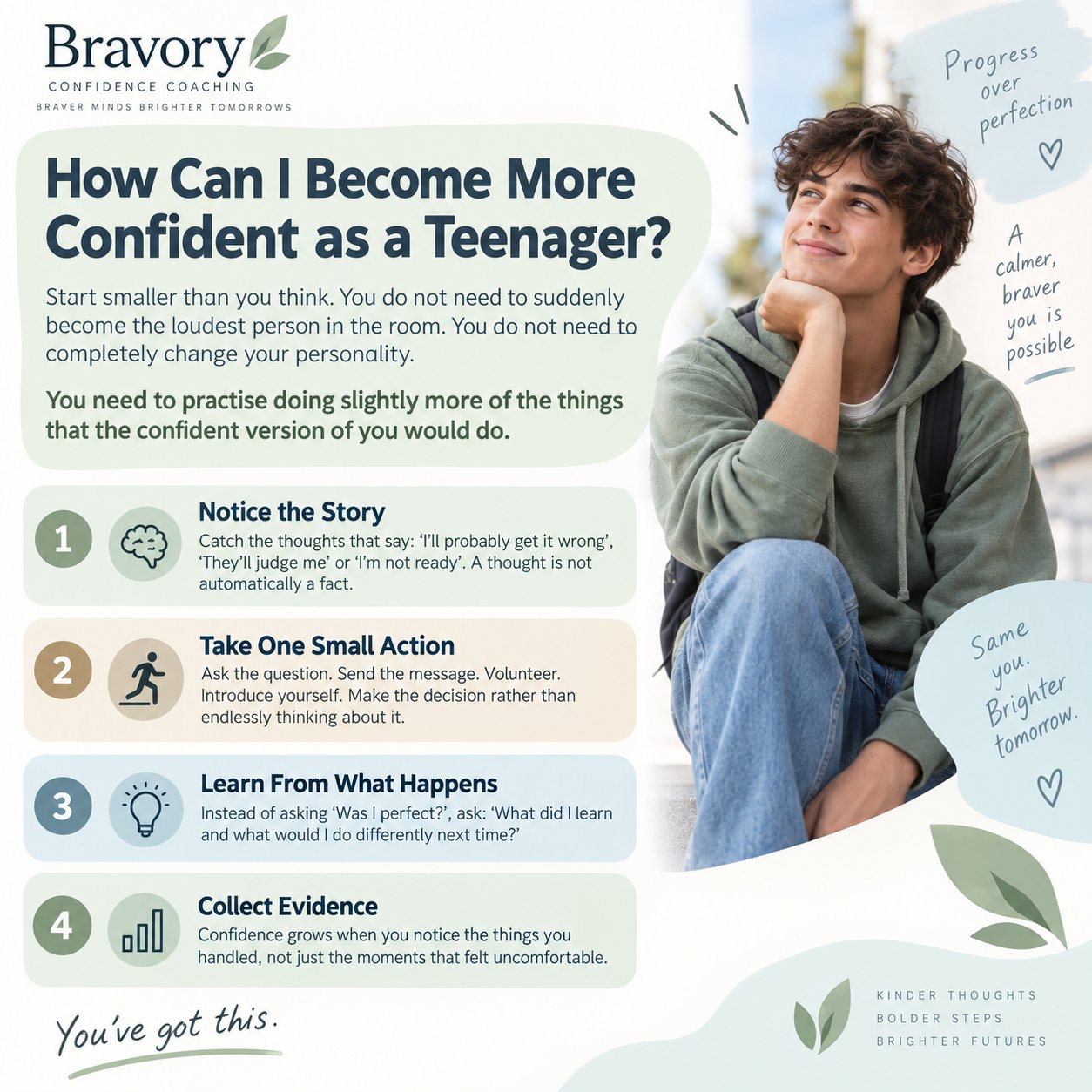
What Does Low Confidence Look Like in Young Adults?
Low confidence does not always mean being shy.
A young adult may appear capable, intelligent, sociable and successful while privately questioning almost every choice.
Overthinking Everything
You spend so long analysing decisions that making one becomes exhausting.
Fear of Getting It Wrong
You delay applications, opportunities or decisions because choosing incorrectly feels frightening.
Comparing Yourself
You feel behind because other people appear more successful, independent or certain.
Social Uncertainty
Meeting people, attending events or entering unfamiliar situations can feel uncomfortable.
Needing Reassurance
You frequently ask parents, friends or partners whether your decisions are right.
Fear of Judgement
You change what you say or do because you are worried about other people's opinions.
Avoiding Opportunities
You want to apply, speak, travel, join or try — but talk yourself out of it.
Imposter Feelings
You worry that eventually somebody will discover you are less capable than they think.
You Don't Need to Have Adulthood Figured Out at 18, 21 or 25
There can be enormous pressure on young adults to know what comes next.
What career do you want?
Do you want university?
Which course?
Which apprenticeship?
Where will you live?
What are your goals?
What is your five-year plan?
Those are useful questions.
But uncertainty does not mean failure.
You don't always need to know:
“What am I going to do with my life?”
Sometimes you only need to answer:
“What is my next useful step?”
Confidence for Young Adults Means Something Different
As you move towards adult life, confidence becomes less about raising your hand in school and increasingly about managing yourself.
It can mean:
- Making decisions;
- Speaking to employers;
- Attending interviews;
- Meeting new people;
- Living away from home;
- Asking for help;
- Managing mistakes;
- Dealing with rejection;
- Setting boundaries;
- Handling difficult conversations;
- Taking responsibility;
- And trusting your own judgement.
That is why confidence and independence are so closely connected.
How to Become More Confident as a Young Adult
Do not begin by trying to completely reinvent yourself.
Confidence normally develops through smaller evidence.
1. Stop Waiting to Feel Ready
There are some things you will never feel completely ready for.
Your first interview.
First day at university.
First proper job.
Moving away.
Travelling alone.
Taking responsibility for something important.
Confidence often arrives after you begin.
You don't need confidence before every action. Sometimes the action creates the confidence.
2. Make More Small Decisions Yourself
If you constantly ask:
“What do you think I should do?”
you may accidentally train yourself to distrust your own judgement.
Before asking somebody else, ask yourself:
- What do I think?
- What information do I have?
- What matters to me?
- What is the realistic risk?
- Which choice makes most sense right now?
Then decide.
Small decisions are practice for bigger ones.
3. Stop Treating Every Decision as Permanent
Young adults can become trapped trying to make the perfect decision.
But many choices can be changed.
Jobs change.
Courses change.
Career plans change.
People move.
Goals evolve.
You do not need a perfect map of the next 40 years before you take the next step.
4. Do More Things Before You Know You're Good at Them
School can accidentally teach us that being good at something is what matters.
Adult life involves being a beginner repeatedly.
You may be bad at:
- Interviews at first
- Presentations
- Networking
- Cooking
- Managing money
- Driving
- Workplace conversations
- Living independently
That's how learning starts.
5. Learn to Handle “No”
You will not get every job.
Every application will not succeed.
Every relationship will not work.
Not everybody will like you.
Resilience is learning that rejection is disappointing without turning it into:
“I'm not good enough.”
6. Build Communication Confidence
Adult confidence involves being able to say:
- “I don't understand.”
- “Can you explain that?”
- “I need help.”
- “I disagree.”
- “I can't do that today.”
- “I made a mistake.”
- “Can I have some feedback?”
Those phrases are signs of maturity, not weakness.
7. Reduce the Number of People Voting on Your Life
Advice can be useful.
But if every decision requires approval from friends, parents, social media and everybody else, you may lose sight of what you actually think.
Listen.
Consider.
Then decide.
8. Keep Evidence of What You Handle
Your brain may remember the interview that went badly while forgetting the five difficult situations you handled successfully.
Keep an evidence list.
Write down:
- Something you did independently;
- A conversation you handled;
- A decision you made;
- A problem you solved;
- A setback you recovered from;
- Something you did despite feeling nervous.
Confidence becomes stronger when it has evidence.

Confidence Before University
Starting university can be exciting and intimidating at exactly the same time.
You may be worrying about:
- Making friends at university
- Living away from home
- Meeting flatmates
- Speaking in seminars
- Joining societies
- Managing your own time
- Cooking and looking after yourself
- Being academically good enough
- Homesickness
- Or simply fitting in
You do not need to arrive as the finished version of yourself.
University is partly where you learn.
That includes learning about yourself.
A better first-week goal:
Instead of:
“I need to make loads of friends.”
try:
“I will start three conversations.”
Actions are easier to control than outcomes.
Confidence for Apprenticeships and Starting Work
Starting work creates a different set of confidence challenges.
Suddenly you may be surrounded by people older and more experienced than you.
You might wonder:
- Should I already know this?
- What if I make a mistake?
- How do I talk to my manager?
- What if I ask a stupid question?
- How do I speak in meetings?
- What if people don't take me seriously because I'm young?
Remember:
Being new is not the same as being incapable.
A useful phrase is:
“Can I check I've understood what you want me to do?”
Good employers would normally rather you clarify something than quietly guess.
Confidence for Job Interviews
You do not need to walk into an interview feeling completely relaxed.
Interview confidence means being prepared enough to communicate despite the nerves.
Prepare examples of:
- something you achieved;
- a problem you solved;
- a time you worked with others;
- something you learned;
- a difficult situation you handled;
- why you want the opportunity.
Then remember:
An interview is not an examination of your worth as a human being.
It is a conversation about whether you and the opportunity might fit.
Young Adult Social Confidence
Friendships can become more complicated after school.
People move.
Groups change.
Some go to university.
Some start work.
Some travel.
You may suddenly need to make friends without the automatic structure of school.
Social confidence can mean:
- Starting conversations
- Attending things alone
- Joining groups
- Inviting someone somewhere
- Being willing to be new
- And not interpreting every awkward moment as rejection
You do not need to become an extrovert.
You need enough courage to give people the opportunity to know you.
Confidence When Everyone Else Seems Ahead
Young adulthood can feel like a race.
One person graduates.
Another gets promoted.
Someone moves into their own flat.
Someone gets engaged.
Another seems to be travelling the world.
You look at your own life and wonder:
“Am I behind?”
Be careful.
There is no single timetable for adult life.
Someone else's next chapter is not evidence that you are late for yours.
How to Stop Overthinking as a Young Adult
Overthinking can become particularly powerful when decisions feel important.
Career.
University.
Relationships.
Where to live.
Money.
Your future.
Try separating:
What I Know
The facts and information I genuinely have.
What I'm Predicting
The things my mind is imagining might happen.
What I Can Control
The actions and decisions available to me now.
My Next Step
One useful action rather than another hour of thinking.
Thinking is useful when it eventually leads somewhere.
If you are simply repeating the same question, you may need action rather than another answer.
Confidence and Independence for Young Adults
Independence is not waking up one morning and suddenly knowing how adulthood works.
It is built through doing more things for yourself.
Start with:
- Making your own appointments
- Managing your diary
- Making phone calls
- Managing money
- Planning journeys
- Solving everyday problems
- Asking for information
- Making decisions
- Dealing with consequences
- Asking for support when you genuinely need it
Independence does not mean never needing anybody.
It means taking increasing responsibility for your own life.
The Bravory Young Adult Confidence Challenge
Choose one action from each category over the next few weeks.
Independence
Do one thing you would normally ask someone else to do for you.
Communication
Have one conversation you have been avoiding.
Social Confidence
Start a conversation or attend something new.
Decision-Making
Make one reasonable decision without asking several people to approve it.
Resilience
Return to something that did not work the first time.
Opportunity
Apply, volunteer, enquire or put yourself forward for something.
Confidence is easier to build when it becomes something you practise rather than something you wait for.
The BRAVE Method for Young Adults
Bravory uses the BRAVE Method to turn confidence into practical behaviour.
B — Belief
Develop a stronger belief in your own worth, ability and potential.
R — Resilience
Learn to handle setbacks, rejection, criticism and things not going perfectly.
A — Action
Stop waiting for certainty and take manageable steps towards the life you want.
V — Voice
Communicate clearly, express opinions, ask questions and speak up when it matters.
E — Evidence
Notice everything you handle so confidence becomes grounded in your own experience.
A Simple Confidence Question for Young Adults
When you feel stuck, ask:
“What would I do next if I trusted myself 10% more?”
Not 100%.
Just 10%.
Would you:
- apply?
- send the email?
- make the call?
- speak to someone?
- go alone?
- ask the question?
- say no?
- move forward?
Choose one.
Then create some evidence.
For Parents: Helping a Young Adult Become More Confident
Supporting a young adult is different from supporting a younger teenager.
You may still see them as your child.
But they increasingly need opportunities to become the adult responsible for their own choices.
That transition can be uncomfortable for both of you.
You can see the mistake before they make it.
You know what you would do.
You want to save them time, money or disappointment.
Sometimes stepping in is appropriate.
But sometimes confidence develops because you don't.
Instead of immediately giving the answer, try:
“What do you think?”
“What are your options?”
“What do you think the consequences might be?”
“What feels right to you?”
“What support would actually help?”
That moves you from making the decision for them to helping them think.
Support Without Taking Over
There is a big difference between:
“You are on your own now.”
and:
“I'm here when you need me, but I believe you can handle more than you think.”
Healthy independence includes support.
The difference is that support gradually becomes something the young adult chooses and uses rather than something automatically imposed.
Take a Bravory Confidence Scorecard
If you are unsure where confidence is getting stuck, start by identifying the area.
It might be:
- self-belief;
- communication;
- resilience;
- social confidence;
- decision-making;
- independence;
- fear of judgement;
- or overthinking.
Bravory's confidence assessment already explores self-belief, communication, resilience, friendships and independence, giving young people a practical starting point rather than simply telling them to “be more confident”. :contentReference[oaicite:2]{index=2}
Take the Bravory Confidence ScorecardConfidence Coaching for Young Adults Through the Bravory 6-Week Programme
Understanding your lack of confidence is useful.
But eventually you need to practise doing things differently.
The Bravory 6-Week Teen Confidence Mastery Programme is also designed for young adults who want a practical route from self-doubt towards greater confidence and action.
The programme helps young people practise:
- Building self-belief
- Managing overthinking
- Making decisions
- Communicating confidently
- Meeting new people
- Handling setbacks
- Taking responsibility
- And acting before everything feels perfect
The current Bravory programme specifically includes young adults, college students, interview preparation, work experience, apprenticeships, social confidence and decision-making. :contentReference[oaicite:3]{index=3}
Explore the 6-Week Confidence ProgrammeExplore More Bravory Support for Young Adults
Teen & Young Adult Confidence Programme
A practical six-week route for building self-belief, communication, resilience and confidence through action.
Explore the ProgrammeSocial Confidence
Build confidence meeting people, joining conversations and navigating new social situations.
Explore Social ConfidenceCommunication Skills
Develop the confidence to speak up, ask questions, express opinions and handle difficult conversations.
Explore Communication SkillsOverthinking Help
Learn practical ways to stop repeatedly second-guessing decisions and start taking useful action.
Explore Overthinking HelpResilience
Learn how to handle setbacks, rejection, disappointment and uncertainty without giving up.
Explore ResilienceFear of Judgement
Explore what happens when worrying about other people's opinions starts making your decisions.
Read the GuideConfidence Coaching Is Not Therapy
Bravory focuses on confidence, communication, resilience, independence and personal development.
It is not therapy, counselling or mental-health treatment.
Low confidence and overthinking can sometimes exist alongside more significant mental-health difficulties.
If you or a young adult you care about is experiencing severe anxiety, depression, trauma, an eating disorder, self-harm, suicidal thoughts, abuse, addiction or another serious concern, speak with an appropriate qualified healthcare or mental-health professional.
Where there is immediate danger or a safeguarding concern, seek urgent professional help.
Frequently Asked Questions About Confidence for Young Adults
How can I become more confident as a young adult?
Start by identifying where confidence is holding you back, then practise manageable actions. Make more decisions yourself, speak up, try new situations, learn from mistakes and keep evidence of what you successfully handle.
What is confidence coaching for young adults?
Confidence coaching for young adults focuses on practical personal development skills such as self-belief, decision-making, communication, resilience, social confidence and independence. It aims to help young adults take useful action rather than simply waiting to feel more confident.
Can confidence coaching help before university?
Confidence development can help young adults prepare for meeting new people, living more independently, speaking in seminars, managing decisions and handling the uncertainty that comes with starting university.
Can confidence coaching help with starting work?
Confidence skills can be useful for interviews, apprenticeships, first jobs, speaking to managers, asking questions, handling feedback, communicating with colleagues and becoming more independent in the workplace.
Why do I have low confidence even though other people think I'm capable?
Capability and confidence are not the same thing. You may have plenty of ability while still doubting your judgement, fearing mistakes or worrying about other people's opinions. Confidence often grows when you start collecting your own evidence of what you can handle.
How do I stop comparing myself with other young adults?
Notice when you are comparing your full life with somebody else's visible achievements. Focus on your own next step, values and progress rather than using another person's timeline as the measure of your success.
How can parents help a young adult become more confident?
Support without automatically taking over. Ask what they think, encourage them to make age-appropriate decisions and allow them to handle manageable consequences. Confidence grows when young adults discover what they can do for themselves.
Is Bravory suitable for young adults?
Yes. Bravory supports teenagers and young adults who want to develop confidence, self-belief, resilience, communication, decision-making and greater independence through practical personal-development activities.
You Don't Need to Become a Different Person
Confidence isn't becoming louder.
It isn't pretending you have everything figured out.
It isn't walking around believing you can never fail.
Young adult confidence can look much simpler.
It can be:
- Making the phone call yourself
- Walking into somewhere new
- Asking a question
- Attending the interview
- Making a decision
- Saying no
- Trying again after rejection
- Meeting somebody new
- Admitting you don't know
- Taking responsibility for what happens next
Confidence isn't having your whole future worked out. It is trusting yourself enough to keep moving while you work it out.
Your Next Brave Step
Think about one part of adult life where you currently feel stuck.
University?
Work?
Friendships?
Independence?
Decisions?
Your future?
Then ask:
“What would I do next if I trusted myself just 10% more?”
Don't try to solve your entire future today.
Take the next step.
Then let that step become evidence.
Explore the 6-Week Confidence Programme Take the Confidence Scorecard