“Why Doesn't My Teenager Believe in Themselves?”
Perhaps this is the question that brought you here.
Your teenager might say things like:
- “I'm not good enough.”
- “Everyone else is better than me.”
- “I'll probably mess it up.”
- “What's the point? I won't get it anyway.”
- “I look awful.”
- “Nobody likes me.”
- “I can't do that.”
- “I'm just not a confident person.”
Or perhaps they do not say any of those things.
Instead, you see it in what they don't do.
They avoid opportunities. They stay quiet. They give up quickly. They need reassurance before making simple decisions. They compare themselves with friends. They refuse to try something unless they already know they will be good at it.
Sometimes they may appear not to care at all.
And that can leave you wondering:
Is this normal teenage behaviour, or is my teenager struggling with low self-esteem?
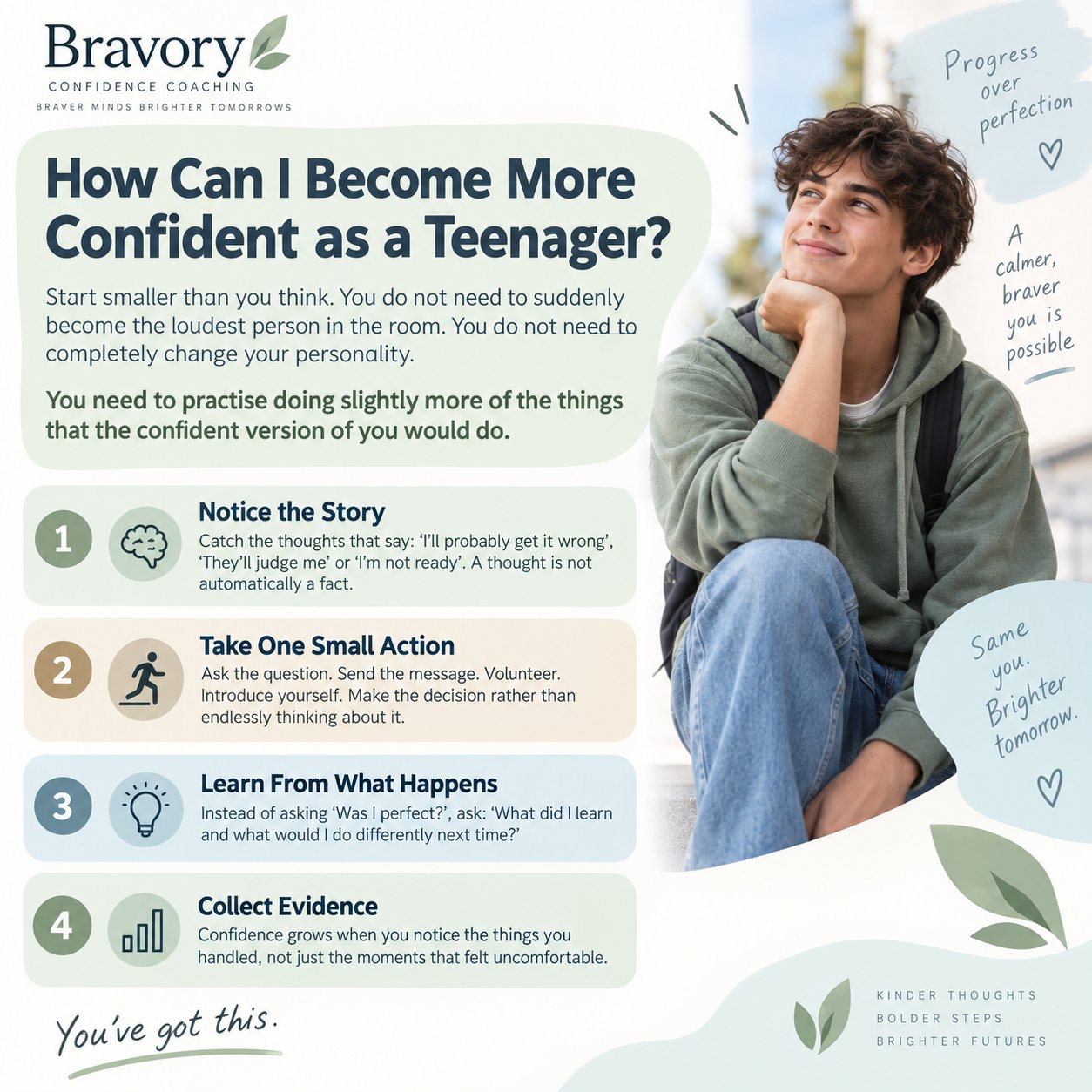
What Does Low Self-Esteem in Teenagers Actually Look Like?
Low self-esteem is not simply being shy, quiet or occasionally uncertain.
Most teenagers doubt themselves sometimes.
The bigger question is whether self-doubt is beginning to influence the choices your teenager makes about themselves, their relationships, school, college, work or their future.
A teenager with low self-esteem may begin to build an internal story that says:
“People like me aren't good at things like that.”
And once they start believing that story, it can affect what happens next.
They may avoid the very experiences that could have shown them they were capable.
Signs of Low Self-Esteem in Teenagers
There is no single checklist that tells you whether a teenager has low self-esteem, but you may notice a pattern of behaviours.
Negative Self-Talk
They regularly criticise themselves or describe themselves as stupid, ugly, useless, awkward or not good enough.
Constant Comparison
They measure themselves against friends, classmates, siblings, influencers or people they see online.
Fear of Getting Things Wrong
Mistakes feel threatening rather than something normal that can be learned from.
Avoiding New Things
They would rather not try than risk discovering that they might not be immediately good at something.
Needing Reassurance
They frequently ask other people whether they have made the right decision, look OK or are doing well enough.
Perfectionism
Anything less than perfect can feel like failure, making it difficult to start, finish or enjoy things.
Holding Back Socially
They may avoid meeting new people, speaking in groups, joining activities or expressing their real opinion.
Giving Up Before Trying
“I can't” appears before they have had enough experience to discover whether they actually can.
One behaviour on its own does not tell the whole story. What matters is the pattern, how long it has been happening and how much it is limiting your teenager's everyday life.
Low Self-Esteem Doesn't Always Look Like Low Confidence
This is important.
Some teenagers who struggle with self-esteem do not look shy at all.
They may be funny, loud, popular or confident around friends. They might achieve highly at school or be excellent at sport.
But underneath that outward confidence there can still be a strong fear of failure, rejection or not being good enough.
Sometimes low self-esteem can hide behind:
- Perfectionism;
- Sarcasm;
- Putting themselves down before someone else can;
- Pretending not to care;
- Procrastination;
- Avoiding responsibility;
- Constant reassurance-seeking;
- Being extremely sensitive to criticism;
- Or refusing opportunities they secretly want.
So rather than simply asking “Does my teenager look confident?”, it can be more useful to ask:
“How much does my teenager trust themselves when something feels uncertain?”

Why Do Teenagers Develop Low Self-Esteem?
There is rarely one simple reason.
Teenagers are developing their identity at the same time as they are dealing with friendships, school, exams, appearance, relationships, social media, changing expectations and questions about their future.
Their self-esteem may be affected by experiences such as:
- Comparing themselves constantly with other people;
- Friendship problems or rejection;
- Bullying;
- Academic pressure;
- Feeling they have disappointed someone;
- Fear of failure;
- Social media comparison;
- Changes in appearance;
- Feeling different from their peers;
- Repeated criticism;
- Perfectionism;
- Setbacks they have taken personally;
- Or simply not yet having enough experiences that show them what they are capable of.
Understanding the possible reason can help.
But parents do not need to diagnose every cause before they can begin helping.
Sometimes the most useful starting point is simply:
“What is this lack of self-belief stopping them from doing?”
How to Help a Teenager With Low Self-Esteem
It is tempting to think the solution is to tell your teenager how brilliant they are.
And there is nothing wrong with encouragement.
But if your teenager already believes “I'm not good enough”, simply saying “Of course you are!” may not change the story they are telling themselves.
The longer-term goal is to help them start creating their own evidence.
1. Listen Before Trying to Fix It
If your teenager tells you something they are worried about, resist the urge to immediately explain why they are wrong.
Instead of:
“Don't be silly. Of course people like you.”
you might start with:
“It sounds as though that's really bothering you. What happened?”
Understanding first often creates a better conversation than reassurance first.
2. Separate a Bad Outcome From Who They Are
Getting a poor mark does not make somebody stupid.
Not getting selected does not make somebody a failure.
An awkward conversation does not mean somebody is socially hopeless.
Help your teenager learn the difference between:
“Something didn't go well”
and
“There is something wrong with me.”
3. Help Them Notice Their Inner Critic
Teenagers can become so used to speaking negatively to themselves that they stop noticing it.
Encourage them to catch thoughts such as:
- “I'll look stupid.”
- “Nobody wants me there.”
- “I'm rubbish at everything.”
- “Everyone else has got their life sorted.”
Then ask:
“Is that definitely a fact, or is that what you're predicting?”
4. Encourage One Small Brave Action
Self-esteem rarely changes through thinking alone.
Young people need experiences.
So make the step small.
It might be:
- Asking one question;
- Speaking once in a group;
- Making their own phone call;
- Joining one activity;
- Sending the message;
- Applying for the opportunity;
- Making one decision themselves;
- Or trying something without knowing whether they will be good at it.
Small actions create evidence.
5. Praise Courage, Effort and Recovery
If we only praise successful outcomes, teenagers can accidentally learn that success is what makes them valuable.
Notice other things too:
- “You were nervous and you still did it.”
- “That didn't work, but I noticed you tried again.”
- “You made that decision yourself.”
- “You handled that conversation well.”
- “You didn't get the result you wanted, but you recovered.”
Those observations help teenagers notice capability rather than only achievement.
6. Give Them Opportunities to Make Decisions
If we make every decision for a young person, they have fewer opportunities to learn:
“I can trust my judgement.”
Give them increasing responsibility where it is appropriate.
Allow some safe mistakes.
Then ask what they learned rather than immediately telling them what they should have done.
7. Stop Trying to Remove Every Uncomfortable Feeling
Nobody wants their child to feel embarrassed, rejected, nervous or disappointed.
But confidence does not come from never experiencing those feelings.
It often grows from discovering:
“That was uncomfortable, but I handled it.”
A Simple Question That Can Change the Conversation
The next time your teenager brings you a problem, try asking:
“Do you want me to listen, help you think it through, or help you decide what to do next?”
That small question can help you move from automatically fixing the problem to helping your teenager think for themselves.
It still says:
“I'm here.”
But it also says:
“I believe you are capable of being involved in the solution.”
What Not to Say to a Teenager With Low Self-Esteem
Parents usually say these things because they care. But some phrases can unintentionally close down the conversation.
“Just be confident.”
If they knew how to do that, they probably already would.
“You're being ridiculous.”
What feels small to an adult can feel very real to a teenager.
“You shouldn't care what people think.”
Most people care what others think sometimes. Help them reduce its influence rather than pretending it does not matter.
“When I was your age...”
Your experience can help, but only if it does not make their current experience feel dismissed.
“I'll sort it out.”
Sometimes that is necessary. But constantly rescuing can unintentionally reduce opportunities for independence.
“But you're amazing!”
Warmth matters, but encourage them to discover evidence for themselves too.
The Bravory Approach: From Reassurance to Evidence
At Bravory, we approach confidence and self-belief as skills that young people can develop through reflection and action.
The aim is not to convince a teenager they are wonderful every five minutes.
It is to help them gradually become able to say:
- I can speak up even when I feel nervous.
- I can make a decision without checking with everybody else.
- I can get something wrong without deciding I am a failure.
- I can deal with somebody not liking my choice.
- I can learn from mistakes.
- I can try something new before I know whether I will be good at it.
- I can recover from disappointment.
- I have strengths worth recognising.
- I have a voice.
- I can handle more than I sometimes think.
Self-belief becomes stronger when a teenager has evidence, not just reassurance.
How the BRAVE Method Helps Build Self-Belief
Bravory uses the BRAVE Method to help teenagers understand and develop confidence.
B — Belief
Recognising strengths, questioning unhelpful self-talk and developing a healthier belief in what they can do.
R — Resilience
Learning that mistakes, rejection and setbacks do not define them.
A — Action
Taking small practical steps rather than waiting until they suddenly feel confident.
V — Voice
Learning to communicate, express an opinion, ask questions and speak up when it matters.
E — Evidence
Collecting real examples of things they have handled so their belief becomes grounded in experience.
Start by Finding Out What's Really Holding Them Back
Low self-esteem can show itself in different ways.
For one teenager, the biggest difficulty may be worrying about other people's opinions. For another it could be overthinking. For somebody else it could be social confidence, resilience, independence or fear of difficult conversations.
That is why understanding the starting point matters.
Try the Bravory Teen Confidence Test
The Bravory Teen Confidence Test explores areas including self-belief, social confidence, resilience, communication and independence.
There is a route for teenagers and a separate route for parents and guardians.
It is designed to identify possible confidence strengths and gaps, rather than attach a label to a young person.
Take the Teen Confidence TestReplace the link above with the exact URL of your Teen Confidence Test page.
Then Turn Understanding Into Action
Understanding why a teenager lacks confidence is useful.
But understanding alone will not build self-esteem.
Young people need opportunities to practise.
That is where the Bravory 6-Week Teen Confidence Mastery Programme comes in.
The programme provides a structured route to help teenagers and young adults develop:
- Self-belief;
- Confidence;
- Communication;
- Decision-making;
- Resilience;
- Greater independence;
- Awareness of their inner critic;
- And the courage to take action.
Rather than simply telling young people to believe in themselves, the programme encourages them to practise confidence in real situations and build evidence through experience.
Explore the 6-Week Teen Confidence Mastery ProgrammeMore Bravory Support for Parents and Teenagers
If you are trying to understand what is happening before deciding what support your teenager needs, these Bravory resources can help.
Parent & Guardian Hub
Practical guidance for parents trying to support confidence, resilience, communication and independence without taking over.
Explore Parent SupportParent Conversation Kit
Sometimes the first challenge is simply getting a teenager to talk. Use questions designed to create better conversations rather than interrogations.
Explore the Parent Conversation KitConfidence Building for Teens
Discover practical confidence-building steps parents can encourage at home.
Read the Confidence Building Guide6-Week Confidence Programme
Move from reading about confidence to actively developing self-belief through structured learning and practical action.
Explore the ProgrammeWhen Low Self-Esteem May Need More Than Confidence Training
Bravory is confidence, communication and personal development training. It is not therapy or mental-health treatment.
Sometimes low self-esteem exists alongside more significant emotional or mental-health difficulties.
If your teenager is experiencing significant distress, persistent low mood, severe anxiety, eating difficulties, self-harm, suicidal thoughts, trauma, abuse or you are concerned about their safety, confidence training should not replace appropriate professional help.
If you are concerned about a young person's mental health or safety: speak with an appropriate healthcare professional, GP, school safeguarding lead, counsellor or relevant specialist service.
Frequently Asked Questions About Low Self-Esteem in Teenagers
What are the signs of low self-esteem in a teenager?
Possible signs include frequent negative self-talk, avoiding challenges, comparing themselves negatively with others, seeking constant reassurance, fear of failure, perfectionism, difficulty making decisions, social withdrawal or giving up before trying.
How can I help a teenager with low self-esteem?
Listen before trying to fix the problem, help them recognise unhelpful self-talk, encourage age-appropriate decisions, provide manageable opportunities to try new things and notice courage, effort, learning and recovery rather than only successful outcomes.
Why does my teenager think they aren't good enough?
There may not be one single reason. Social comparison, friendships, school pressure, setbacks, appearance, perfectionism, criticism, social media and fear of rejection can all influence how a teenager sees themselves. Focus on understanding their individual experience rather than assuming one cause.
Should I keep reassuring my teenager?
Reassurance can be helpful, but constant reassurance should not be the only strategy. Help teenagers develop their own evidence by making decisions, taking manageable risks, trying things and recognising what they successfully handle.
Can teenage self-esteem improve?
Self-belief can develop as young people gain experience, learn from setbacks, challenge overly negative assumptions and recognise what they are capable of. Progress is often gradual rather than a sudden transformation.
Is Bravory therapy?
No. Bravory provides confidence, communication, resilience and personal development training for teenagers and young adults. It is not therapy or a substitute for professional mental-health treatment where that is required.
How does the Bravory 6-week programme help?
The Bravory Teen Confidence Mastery Programme gives young people a structured way to understand self-doubt, develop communication and decision-making skills, practise confidence and build self-belief through real-world action.
Your Teenager Doesn't Need to Become Somebody Else
One of the most important things to remember is that building self-esteem does not mean turning a quiet teenager into an extrovert.
They do not need to become louder.
They do not need to be fearless.
They do not need to stop caring completely about what other people think.
They need to become increasingly able to recognise:
“I have value. I have a voice. I can learn. I can make decisions. I can deal with things not going perfectly. And I can take the next step.”
That is a very different kind of confidence.
And it can be developed one small piece of evidence at a time.
Help Your Teenager Start Building Their Own Evidence
If you can see more potential in your teenager than they currently see in themselves, you do not have to solve everything for them.
You can help them take the next step.
Start by exploring what may be holding them back, then help them turn understanding into small practical actions.
Explore the 6-Week Teen Confidence Programme Explore the Parent Conversation Kit